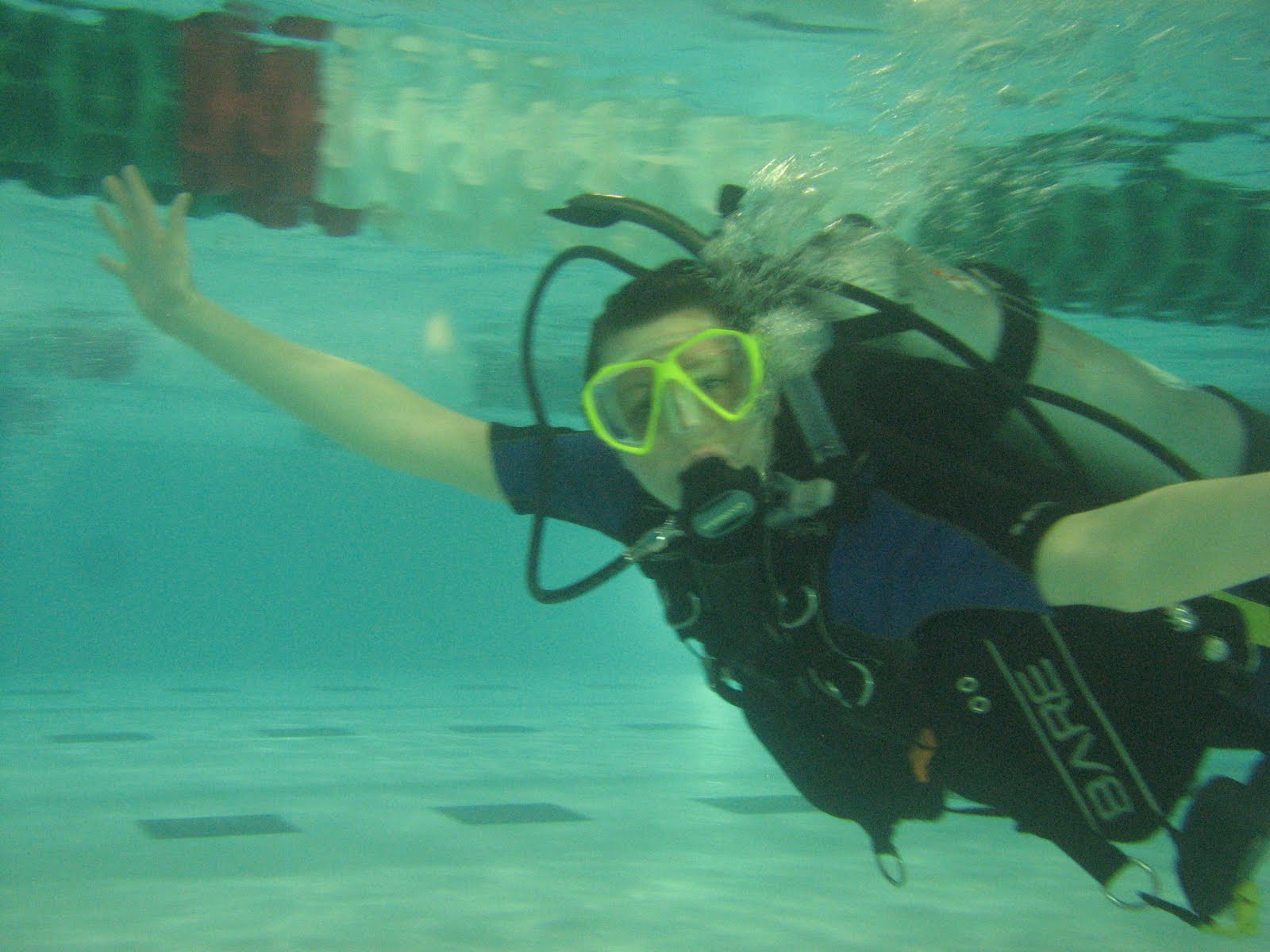
Following my amazing night of diving with friends Enjoying the view before gearing up to explore the wonders beneath! it was time to catch up with the divers of Ocean Pro for a fun day of diving and good food. After a quick clean of the cabin and loading all the gear back into the vehicles we headed over to the main parking lot to find and hold spots for the rest of the group who would soon be arriving. With the sun coming up and a warm day ahead we started by laying out any of our gear that had not totally dried over night and started putting our kits together in preparation for the day.
It seemed only minutes before the parking lot was full and the air was filled with the talking and planning of the days activities. Amongst the group joining the activities were my close friends and instructors Virpi Kangas and Ward Conley, their plan for the day was taking them out in Wards small boat so they could dive the Nakaya. Other groups were heading out to swim the fire-hose, while others were setting out to explore the Leaning Tower of Porteau or the Sailboat Hull and others still were off to explore the Granthall.
My dive partner for dive 1 of the day was an experienced diver joining the Ocean Pro BBQ for the first time. Equipped with his twin tanks and local knowledge it looked like it was going to be another relaxing day of diving... boy was I in for a surprise...lol. Apparently swimming as fast as possible was an on-going trend for this weekend. Not long after entering the water my dive buddy started his quest for an Olympic medal in swim sprints...lol. It was all I could do for the most part to keep up and finally signal my buddy to slow down, by this time unfortunately I had burned much of my air so it was time to make my turn and head back. My dive buddy on the other hand, swimming with twins, had lots of air and was less than agreeable to returning quite yet. After a quick conversation through hand signals it was decided to make another pass around the Granthall, this time very slowly and breathing under control, then after our pass, we followed the chain up to 15 feet where we did our safety stop sharing the air in his twins and then made our way the last 15 feet to the surface. On the surface the tides had changed from the night before and now the surface current was now heading away from shore, making the surface swim a lot more challenging. After a bit of a fight against the current to gain a few feet it became apparent that it wa going to be easier to work together. So taking turns doing the tired diver tow with us both kicking the whole time we were able to make faster progress against the current and reach shore in time to see the burgers coming off the grill.
Stripping down my gear and switching out my tank only took a couple minutes then it was time to open up my dry suit and enjoy the fresh air drifting into my suit and cooling my body down. Soon most of the rest of the divers who had not already returned made their way over to the big Ocean Pro Divers tent to find their fill of food and stories about the first dive of the day.
After a quick meal, and some good conversation it was time to catch up with my buddy for dive 2, who happened to be the same buddy from the night before. Dive planning for our last dive of the weekend was pretty simple, both of us a little tired from the night before and from our surface swims from dive 1 on the day, agreed we would dive similar to dive 2 from the previous night. Surface swim out a short distance and then descend and let the water moves us around while we explored the open ocean floor. Finding our neutral buoyancy and just floating in the water with soft gentle kicks to change direction or increase rate and it wasn't long before the current had moved us back out to the Granthall, a couple circles and then over to the fire-hose which we started to follow back towards the first marker. Then it happened, they tell you it happens but until it does you don't know what it's going to be like. I stopped, spotting a particularity interesting plant that appeared to be swimming, and decided to snap a few pictures.
1, 2, 3 frames later and I look to my buddy.... he's gone... nowhere to be seen. Random clouds of silt can be seen in a few directions, unfortunately due to the large number of divers in the water clouds of silt could be evidence of any diver. So, checking my watch and marking the time, then resuming my previous pattern sweeping side to side it was time to look for my buddy. 15 seconds, nothing, 30 seconds, nothing, 45 seconds, nothing, a minute.... nothing! Now it was time to hope my buddy was ok and would stick to our plan, if separated, look for a minute, then head to the surface. So... off to the surface I went spinning 360 degrees during my ascent looking to see if my buddy could be spotted. Upon breaching the surface, I again started my 360 degree surface search looking for any sign of my buddy. Only problem, lots of divers on the surface.... unfortunately... my buddy was not one of them... Could it be that my buddy hadn't noticed I wasn't with him? Is he ok? Where is he? Seconds seemed like minutes and two minutes seemed like twenty. Still spinning on the surface looking and then there, about 200 feet in toward shore, was my buddy, waving and signalling "OK". Taking a navigational heading to where he was and indicating to stay in place, I descended to avoid the strong surface current and swam the distance following tight to my navigational heading and close to the bottom surfacing just beyond arms distance from my buddy. Staying close and both stilled stunned at how quick we got separated we moved to the stairs and up out of the water to warm up, stow our gear and head home safe, sound and reminded of the importance of strong buddy contact.
Showing posts with label Buoyancy. Show all posts
Tuesday, June 7, 2011
Burgers and a Dip!
Monday, June 6, 2011
Enjoying the view before gearing up to explore the wonders beneath!
Saturday afternoon while the Vancouver Canucks were preparing to dish out their punishment on the Boston Bruins, I was meeting up with a few friends at our cabin up at Porteau Cove. The plan for the evening would see us completing 2 dives before calling it a night, catching some sleep and then joining Ocean Pro Divers in the morning for their monthly BBQ and dive day!!
By the time I had arrived at the cabin, my buddy for the night had just arrived and the Canucks were going into OT tied 2 - 2. After grabbing my over-night gear and throwing it on the couch and flipping on the TV, we were just in time to see the puck drop and Alex Burrows suck Thomas out of the net, out skate Chara, and wrap around the net depositing the puck in the back of the net taking game 2 sending the Boston "ruins" back home to lick their wounds.
Shortly after the game, the third member of our group arrived and started preparing his dinner while I walked down towards the shore to look and see what the tides were looking like for the evening and was met with this wonderful view:
The water was so calm, only a few clouds in the air, conditions we dream about!
After my walk, the last of our team had arrived for the night and we loaded our gear and headed for the shore. Taking our time to discuss the plans for the night and review any concerns we geared up and decended the stairs to start our first dive of the evening.
Surface swimming out to the first marker, the plan was to descend to the bottom, group up and move out along the fire hose exploring the darkened ocean floor. Upon reaching the bottom and forming up in our buddy teams we headed out across the bottom. Unfortunately the other group of divers turned out to be determined to move as quick as possible and since my buddy and I were looking to actually explore the under-sea world instead of watch it blast by while setting a record for how fast we could swim. It did not take long for the other group to pull well ahead of us as we watched their lights dim into the distance. Signalling to my buddy we slowed down to a complete stop, checked air, confirmed depth and started a slow patrol of the bottom moving in the general direction of the second marker. After slowly exploring and capturing a few photos we started our slow return back towards the stairs watching as the fish dashed in and out of our beams of light. Before we knew it, nearly 40 minutes had passed and we were watching as the bottom angled up and our depth drew down. By 45 minutes we were back at the base of the stairs, regs out, fins off and then the short walk back to the vehicles to switch tanks and head back.
As it turned out, the first group had returned before us and had already stripped down their gear and packed it away. One of the divers had decided to wear a wet-suit for the night, so after dive one he was uncomfortably cold and his buddy had decided one dive was enough for the night. My partner and I, however, couldn't wait to get back in the water so while our friends headed back to the cabin we headed back out into the water, this time with a slightly different plan.
With me taking the lead we surface swam out just far enough to have about 10 feet of water below us before we descended. Upon reaching bottom, we checked for neutral buoyancy, confirmed air and direction and then completely relaxed, slowly kicked and let the water move us slowly across the bottom while watching the world move around us. As we approached half air we made a slow turn and moved back towards the stairs enjoying the underwater world and the wonderful life that it revealed to us along with some interesting looking animals that I had never seen before and will have to see if I can find someone to identify.
After finding and photographing our little buddy here we made our way to the stairs and up to the vehicles to strip down our gear and head for the cabin. Back at the cabin we spread out the gear that would be needed for the following morning to allow it to dry a bit before being needed again and headed inside to join the rest of our party.
As it turned out it wasn't much of a party... inside the cabin our other two divers had already found their sleeping bags and were working on catching their zzz's. Quickly grabbing a snack and something warm to drink I headed to bed to snore away my night and dream of what the next day might bring.
By the time I had arrived at the cabin, my buddy for the night had just arrived and the Canucks were going into OT tied 2 - 2. After grabbing my over-night gear and throwing it on the couch and flipping on the TV, we were just in time to see the puck drop and Alex Burrows suck Thomas out of the net, out skate Chara, and wrap around the net depositing the puck in the back of the net taking game 2 sending the Boston "ruins" back home to lick their wounds.
Shortly after the game, the third member of our group arrived and started preparing his dinner while I walked down towards the shore to look and see what the tides were looking like for the evening and was met with this wonderful view:
The water was so calm, only a few clouds in the air, conditions we dream about!
After my walk, the last of our team had arrived for the night and we loaded our gear and headed for the shore. Taking our time to discuss the plans for the night and review any concerns we geared up and decended the stairs to start our first dive of the evening.
Surface swimming out to the first marker, the plan was to descend to the bottom, group up and move out along the fire hose exploring the darkened ocean floor. Upon reaching the bottom and forming up in our buddy teams we headed out across the bottom. Unfortunately the other group of divers turned out to be determined to move as quick as possible and since my buddy and I were looking to actually explore the under-sea world instead of watch it blast by while setting a record for how fast we could swim. It did not take long for the other group to pull well ahead of us as we watched their lights dim into the distance. Signalling to my buddy we slowed down to a complete stop, checked air, confirmed depth and started a slow patrol of the bottom moving in the general direction of the second marker. After slowly exploring and capturing a few photos we started our slow return back towards the stairs watching as the fish dashed in and out of our beams of light. Before we knew it, nearly 40 minutes had passed and we were watching as the bottom angled up and our depth drew down. By 45 minutes we were back at the base of the stairs, regs out, fins off and then the short walk back to the vehicles to switch tanks and head back.
As it turned out, the first group had returned before us and had already stripped down their gear and packed it away. One of the divers had decided to wear a wet-suit for the night, so after dive one he was uncomfortably cold and his buddy had decided one dive was enough for the night. My partner and I, however, couldn't wait to get back in the water so while our friends headed back to the cabin we headed back out into the water, this time with a slightly different plan.
With me taking the lead we surface swam out just far enough to have about 10 feet of water below us before we descended. Upon reaching bottom, we checked for neutral buoyancy, confirmed air and direction and then completely relaxed, slowly kicked and let the water move us slowly across the bottom while watching the world move around us. As we approached half air we made a slow turn and moved back towards the stairs enjoying the underwater world and the wonderful life that it revealed to us along with some interesting looking animals that I had never seen before and will have to see if I can find someone to identify.
After finding and photographing our little buddy here we made our way to the stairs and up to the vehicles to strip down our gear and head for the cabin. Back at the cabin we spread out the gear that would be needed for the following morning to allow it to dry a bit before being needed again and headed inside to join the rest of our party.
As it turned out it wasn't much of a party... inside the cabin our other two divers had already found their sleeping bags and were working on catching their zzz's. Quickly grabbing a snack and something warm to drink I headed to bed to snore away my night and dream of what the next day might bring.
Monday, April 25, 2011
Flutter kick, flutter kick goes the Easter Bunny....
Well, I guess if fish can lay eggs under the water, why couldn't a bunny... or bunnies... bunnies from Langley Diving. Last week I was fortunate enough to receive an email from Langley Dive inviting me to join them on the weekend for their Easter Egg hunt at Porteau Cove. I am assuming that because Langley Dive were involved in the Whites Demo that I participated in they ended up with my email address. However they got it, they did, and I was off to Porteau to hunt for eggs for the first time since being a kid, and for the very first time under-water.
Saturday was a beautiful day and with the meet time scheduled for 10:00 am it was late enough to get a good sleep and enjoy a leisurely drive and still have tons of time to assemble my gear before anyone else arrived for the day. Up at the dive site at just after 9:00 allowed me ample time to pull out my kit and take my time to assemble everything then walk out an look at the conditions, and then head over to the Langley Dive van to see what the plan was. After a couple of minutes, one of the Bunnies, Monique Score, having finished her dive, came over to say hello and welcome me to the dive. A few minutes later I met Rebecca Barrett, another Instructor from Langley Dive and the second Dive Bunny. Soon a group had formed, and Monique and Rebecca called everyone together to welcome us and let us know the details of today's adventure.
Earlier in the day Monique and Rebecca had placed twenty-seven (27) eggs beneath the surface of the water, no deeper than 50 feet, on the surfaces of the Granthall, Centennial, Sailboat Hull, Jungle Gym, Tire Reef and along the Fire Hose. The idea was simple, go, collect, return, YEAH!...lol.
Monique had already introduced me to my dive buddy for the day, a recent graduate of the Open Water program at Langley Dive in January and excited about his 5th dive and first time in Porteau Cove. I was also able to meet another diver, excited to get back in the water for his 6the dive following his completion of his Open Water back in September. Both divers (and even Monique) seemed a bit surprised to hear I have not been certified all that long myself (end of August) and was headed out for dives 36 and 37...lol. I was also delighted to speak with one of the new divers as he is also a Detroit Red Wings fan, and amidst a sea of Canucks fans these days as the team throws away game after game it was interesting to see the Red Wings hat from across the parking lot... too bad I forgot mine. After some hockey talk and more importantly red Wings nostalgic talk, he headed to meet up with his buddy and me with mine as we all donned gear, finished our buddy checks, being very thorough as this was the most junior group of divers I had been out with to date, odd being the experienced diver for once...lol. With everything secure where it needed to be and dive plan discussed it was time to get in the water.
Our plan for dive one, to keep it simple, was to swim out to the first marker buoy descend and follow the fire hose out and over to the sailboat and reef and eventually the Granthall and all going well and air holding out, slowly make our way back in and reduce our surface swim as much as possible. For those divers who have only ever done Porteau Cove, their first dive at Whytecliff is a shock because there is a long walk to the beach with all your gear on, for those who have only ever done Whytecliff Park and come to Porteau, you are blessed by the amazingly short walk (unless the tide is way out) but the ground slopes so slowly you need to surface swim a good distance before you can get anywhere that has some depth... all about what you want...lol. So my new buddy and I got in the water, fins on, masks on and started our surface swim... fortunately doing the first buoy it is not really a long swim and we managed to talk a bit on the way out comparing Whytecliff to some of the things he would see here at Porteau. Once close to the buoy, we caught our breath, put in our regulators and signaled for descent and BAM! it hit me... I was in charge of this dive... I was the senior diver... if we got lost... or had issues... or got eaten by a ravenous squid-a-pus (you can meet Kraken in Diving, Dinner, Demo's and the RCMP...) it would all be my fault...lol. My nerves were not really put at ease when we descended either, as we broke the surface I quickly realized that seeing my buddy 5 feet away was a bit of a struggle, never mind seeing something further away than that....like the chain we were supposed to be following down...lol. So on the ground we headed in what I "thought:" was the right direction... and with a couple glances at my compass.. someone had moved the hose!...lol That had to be it.. there was no way I was lost... could I be?... yup... I was lost....and realizing nothing was where I left it...lol.. I signalled to my buddy and we ascended back up to re-orient to our target.
We actually didn't end up too far off target, we were further North-East then I had planned so a little plan change and a solid compass bearing marked us dead online to the second buoy. Descending again and watching my compass we made a straight line to the 2nd marker, found the fire hose with no issue and continued on through the jungle gym and to the surface of the Centennial where I found a rock painted like an Easter egg. With the egg in my pocket, and my buddy beside it was off to the Granthall where I managed to find 2 plastic Easter eggs that had been placed beside the Plumose Anemone so they were each almost invisible as the colors were blending in. Our return trip over the Centennial led to my buddy finding a painted rock similar to mine before we turned towards shore and then towards the surface for a decent surface swim.
Back up at the vehicles with the tanks off our back it was time to grab our lunches and check in with Monique and Rebecca. A couple sandwiches later, a nice cup of hot chocolate and a couple cookies and I was all good to go again...lol. Gathered around the Langley Dive van Monique showed us where the numbers were on the bottom of our plastic eggs, turned out the painted rocks... not part of our search...lol, must have been another group out earlier in the week, perhaps Friday, that missed a couple...lol. So with two plastic eggs I gave one to my buddy (we were a team after-all) and listened as Rebecca called out numbers and passed us all prizes. Then when all the eggs (the ones that had been returned at least) were called, Monique and Rebecca gave out prizes to anyone who was unable to come across an egg in their first dive, so everyone got something anyways.
Dive 2 was my Navigation challenge, I knew (this time) that visibility was going to be tough. So with the plan being similar to dive 1 we decided we would get right up to the buoy and follow the chain to the ground, with a little searching (it's not attached right at the bottom) we found the hose. Then following it we made our slow swim towards the 2nd buoy over the Sailboat hull, passed the Centennial, over the tire reef, through the jungle gym, and around the Granthall (where we each found another egg.) The return trip, with my compass bearing in mind, came almost natural, after looping the Granthall, we headed back through the jungle gym, above the tires around the Centennial (man there are some HUGE ling cod sleeping on that deck) passed the sailboat hull and right back onto the fire hose... Then, following the hose, we made the trek back to the first buoy which was not hard to find this time. You see, this buoy is often used by Open Water classes, so really all you have to look for is large clouds of disturbed silt and you can see where the students are landing at the bottom...lol. A turn to the left through the cloud and sure enough there fighting for their buoyancy were a couple Open Water students..lol. Then keeping on that line it was a straight swim all the way back in. We were able to get so close in that my computer actually turned off, I guess I had been swimming in less than 5 feet of water too long...lol. We actually had to back out into the bay again to take our fins off but it was definitely the closest I have ever come to swimming to the stairs, and certainly without a doubt the best navigation I have ever done.
The route we followed is below:
Well, I always say, it's a great dive if you learned something new and I learned that I can navigate and with a little practice I might actually get good at it. Here's looking forward to Rescue this weekend, Photography the weekend after along with a fun dive and very soon.. the Aquarium!
Saturday was a beautiful day and with the meet time scheduled for 10:00 am it was late enough to get a good sleep and enjoy a leisurely drive and still have tons of time to assemble my gear before anyone else arrived for the day. Up at the dive site at just after 9:00 allowed me ample time to pull out my kit and take my time to assemble everything then walk out an look at the conditions, and then head over to the Langley Dive van to see what the plan was. After a couple of minutes, one of the Bunnies, Monique Score, having finished her dive, came over to say hello and welcome me to the dive. A few minutes later I met Rebecca Barrett, another Instructor from Langley Dive and the second Dive Bunny. Soon a group had formed, and Monique and Rebecca called everyone together to welcome us and let us know the details of today's adventure.
Earlier in the day Monique and Rebecca had placed twenty-seven (27) eggs beneath the surface of the water, no deeper than 50 feet, on the surfaces of the Granthall, Centennial, Sailboat Hull, Jungle Gym, Tire Reef and along the Fire Hose. The idea was simple, go, collect, return, YEAH!...lol.
Monique had already introduced me to my dive buddy for the day, a recent graduate of the Open Water program at Langley Dive in January and excited about his 5th dive and first time in Porteau Cove. I was also able to meet another diver, excited to get back in the water for his 6the dive following his completion of his Open Water back in September. Both divers (and even Monique) seemed a bit surprised to hear I have not been certified all that long myself (end of August) and was headed out for dives 36 and 37...lol. I was also delighted to speak with one of the new divers as he is also a Detroit Red Wings fan, and amidst a sea of Canucks fans these days as the team throws away game after game it was interesting to see the Red Wings hat from across the parking lot... too bad I forgot mine. After some hockey talk and more importantly red Wings nostalgic talk, he headed to meet up with his buddy and me with mine as we all donned gear, finished our buddy checks, being very thorough as this was the most junior group of divers I had been out with to date, odd being the experienced diver for once...lol. With everything secure where it needed to be and dive plan discussed it was time to get in the water.
Our plan for dive one, to keep it simple, was to swim out to the first marker buoy descend and follow the fire hose out and over to the sailboat and reef and eventually the Granthall and all going well and air holding out, slowly make our way back in and reduce our surface swim as much as possible. For those divers who have only ever done Porteau Cove, their first dive at Whytecliff is a shock because there is a long walk to the beach with all your gear on, for those who have only ever done Whytecliff Park and come to Porteau, you are blessed by the amazingly short walk (unless the tide is way out) but the ground slopes so slowly you need to surface swim a good distance before you can get anywhere that has some depth... all about what you want...lol. So my new buddy and I got in the water, fins on, masks on and started our surface swim... fortunately doing the first buoy it is not really a long swim and we managed to talk a bit on the way out comparing Whytecliff to some of the things he would see here at Porteau. Once close to the buoy, we caught our breath, put in our regulators and signaled for descent and BAM! it hit me... I was in charge of this dive... I was the senior diver... if we got lost... or had issues... or got eaten by a ravenous squid-a-pus (you can meet Kraken in Diving, Dinner, Demo's and the RCMP...) it would all be my fault...lol. My nerves were not really put at ease when we descended either, as we broke the surface I quickly realized that seeing my buddy 5 feet away was a bit of a struggle, never mind seeing something further away than that....like the chain we were supposed to be following down...lol. So on the ground we headed in what I "thought:" was the right direction... and with a couple glances at my compass.. someone had moved the hose!...lol That had to be it.. there was no way I was lost... could I be?... yup... I was lost....and realizing nothing was where I left it...lol.. I signalled to my buddy and we ascended back up to re-orient to our target.
We actually didn't end up too far off target, we were further North-East then I had planned so a little plan change and a solid compass bearing marked us dead online to the second buoy. Descending again and watching my compass we made a straight line to the 2nd marker, found the fire hose with no issue and continued on through the jungle gym and to the surface of the Centennial where I found a rock painted like an Easter egg. With the egg in my pocket, and my buddy beside it was off to the Granthall where I managed to find 2 plastic Easter eggs that had been placed beside the Plumose Anemone so they were each almost invisible as the colors were blending in. Our return trip over the Centennial led to my buddy finding a painted rock similar to mine before we turned towards shore and then towards the surface for a decent surface swim.
Back up at the vehicles with the tanks off our back it was time to grab our lunches and check in with Monique and Rebecca. A couple sandwiches later, a nice cup of hot chocolate and a couple cookies and I was all good to go again...lol. Gathered around the Langley Dive van Monique showed us where the numbers were on the bottom of our plastic eggs, turned out the painted rocks... not part of our search...lol, must have been another group out earlier in the week, perhaps Friday, that missed a couple...lol. So with two plastic eggs I gave one to my buddy (we were a team after-all) and listened as Rebecca called out numbers and passed us all prizes. Then when all the eggs (the ones that had been returned at least) were called, Monique and Rebecca gave out prizes to anyone who was unable to come across an egg in their first dive, so everyone got something anyways.
Dive 2 was my Navigation challenge, I knew (this time) that visibility was going to be tough. So with the plan being similar to dive 1 we decided we would get right up to the buoy and follow the chain to the ground, with a little searching (it's not attached right at the bottom) we found the hose. Then following it we made our slow swim towards the 2nd buoy over the Sailboat hull, passed the Centennial, over the tire reef, through the jungle gym, and around the Granthall (where we each found another egg.) The return trip, with my compass bearing in mind, came almost natural, after looping the Granthall, we headed back through the jungle gym, above the tires around the Centennial (man there are some HUGE ling cod sleeping on that deck) passed the sailboat hull and right back onto the fire hose... Then, following the hose, we made the trek back to the first buoy which was not hard to find this time. You see, this buoy is often used by Open Water classes, so really all you have to look for is large clouds of disturbed silt and you can see where the students are landing at the bottom...lol. A turn to the left through the cloud and sure enough there fighting for their buoyancy were a couple Open Water students..lol. Then keeping on that line it was a straight swim all the way back in. We were able to get so close in that my computer actually turned off, I guess I had been swimming in less than 5 feet of water too long...lol. We actually had to back out into the bay again to take our fins off but it was definitely the closest I have ever come to swimming to the stairs, and certainly without a doubt the best navigation I have ever done.
The route we followed is below:
Well, I always say, it's a great dive if you learned something new and I learned that I can navigate and with a little practice I might actually get good at it. Here's looking forward to Rescue this weekend, Photography the weekend after along with a fun dive and very soon.. the Aquarium!
Labels:
Andrew TM Harris,
Buoyancy,
Centennial,
Easter Egg,
Easter Hunt,
Granthall,
Jungle Gym,
Langley Dive,
Langley Diving,
ling cod,
Monique Score,
Porteau Cove,
Rebecca Barrett,
Rescue,
Tire Reef,
Whites
Wednesday, March 23, 2011
D.S.D. and Me....
One Fish...
Two Fish...
Red Fish...
Blue Fish...
Two Fish...
Red Fish...
Blue Fish...
Lol, is it bad that listening in to a Discover Scuba Class reminds me of Dr Seuss....
It's not that I take any training lightly, please don't get me wrong, but it just seems funny to me now after this long (yes I know it's only been 8 months since I took up scuba diving) to listen to topics like the air spaces in your body, and pressurization and over-expansion injuries. Now ask me a year ago and I would have been like "Duh... what?" So I am not really picking on students for not knowing nor the teachers for teaching it, but simply laughing at how after what really is just a blink of an eye, the staff and divers of OPD have ingrained in me the basics so much that they seem like they should be second nature to everyone. Of course I was also surprised to talk to someone the other day who has been diving coming up 8 years and just hit 24 dives... for you math genius' out there, that's 3 dives per year... that's 1 dive every 4 months... If I go more than a few weeks without diving I feel like my body is dehydrating and drying up...lol. When I missed nearly 2 months across Christmas with my ear (see What was that? Speak up and talk into my good ear! for the full story) I came back feeling all uncomfortable and spent much of my first dive back in the water trying to get my buoyancy back (for what it was at the time) I can't imaging waiting months between every dive or years....
Anyway, back on track from my rambling... Earlier this week I was lucky enough to not only listen in on a DSD class (and no I didn't laugh or giggle in the back) but i also got to join in and help out!! How? Well Monday I was in the shop dropping off my gear from diving on the weekend and stopped to talk with Chloe and Shannon and see when Chloe might be able to get back in the water as we are doing the Photography course together in April and wanted to get out and practice a bit before hand, but with her ankle we haven't been able to get out. So in talking to Chloe, Shannon got a smile on her face and looked at me and with her head tilted slightly and eyebrow raised asked "Are you looking for photography practice?" At which point she let me know she had 2 DSD (Discover Scuba Diving) classes running this week and would I be interested in taking the pictures for her classes. Now this was cool for a bunch of reasons, first the DSD classes that were happening were a result of a Groupon ad that Shannon had placed that also happened to link to my Blog, this very Blog you are reading!! Apparently Groupon used my blog entry as part of the review for Ocean Pro (so cool how everything is connected...lol.) so I was potentially going to be in the water with strangers who had seen or even read my blog...lol. Second, Shannon was trusting me with her students! I mean of course real Diving pros were going to be there but wow... I was going to be associated with the shop... woot.. step one complete... next to take over the world... oops sorry wrong plan, that was my one for world domination...lol. Last but certainly not least, it was an opportunity to dive and practice my camera work... what more could one ask for!
So with permission from my wonderful wife (Hello Honey if you are reading this), I agreed to join Shannon's 2 classes and made my way to the shop on Tuesday for class one. Upon arrival I was greeted as always by the smiling face of Shannon who introduced me to some brand new Open Water Students while pointing out that I was helping the shop out by doing photography for them. Then it was off to the front of the store where Matt and Deirdre were teaching their first DSD classes. Standing quietly off to the side I was able to listen in to the way Deirdre and Matt interlaced humor into the night keeping the students on their toes... literally, Matt had everyone standing up and doing imaginary regulator recoveries while trying not to hit their neighbor or wipe out any of the racks in the shop...lol. Before long it was off to the pool, but before I could leave I had to find a pool suit, as luck would have it, Shannon asked what i needed and when she heard pool suit, she walked out onto the floor of her shop and pulled a brand new great quality suit off the rack and passed it to me.... THIS ROCKS!!
Arriving at the pool it was a quick unload of all the gear and then time to get into the pool suits. With suits on and a couple of great photo ops (one wonderful gentleman put the suit on backwards...lol), it was time to sit back and watch the teachers teach. After walking everyone through assembling their kits and turning on their air, it was time to teach them how to work as a team to get their BCD's on. For this Matt let me assist by being his buddy and modeling how to lift, hold and support the kit while your buddy gets in. Then I had the opportunity to assist a few divers as they worked their way into their kits and, of course not ever having anything of this size on their backs before, complain about the weight. Now with everyone geared up it was time to put on my BCD. Now keep in mind that I normally dive 32 lbs of lead (12 in a belt and 20 in my BCD) and a steel 130 cubic foot tank which is 10 lbs heavier than an aluminum 80 cubic foot tank, but for the pool I was only using my 12lb weight belt, cutting the total weight in my BCD by 30 lbs!! So it was no wonder when I picked up my BCD it felt light as air and didn't mean anything to me when I grabbed it like a person grabs a back pack and just flung it over my shoulder with one hand. Now as I said it didn't surprise me, but some of the students on the other hand, seemed a little shocked...lol.
All geared up it was time to head for the shallow end of the pool and start the in-pool exercises. After the basics of putting their faces in the water and emptying and filling their BCD's, it was regulator recover time and a little underwater time before sending them to do laps in the shallow end.
After a few laps it was time to send the students out into the deep end. Waiting for us in the deep today were colored golf balls, mini-torpedoes and other various toys to swim around and play with while enjoying, becoming comfortable with and inevitably Discovering Scuba!!
Labels:
Andrew TM Harris,
Buoyancy,
Chloe Boone,
Deirdre Escalante,
Discover Scuba,
Mathew Mendes,
Ocean Pro,
Ocean Pro Divers,
PADI,
Pool Suit,
Scuba Diving,
Shannon Kozak
Monday, March 21, 2011
To Drift or Not To Drift....
Drift diving to me always sounded like I was going to be pulling a Crush and Spike from Finding Nemo, and be flying along under the surface watching the world fly by. This weekend I tried it.... not so much!...lol.
For yesterday's dives I was "fortunate" enough, that one of the students from the shop managed to tear the zipper in the suit I normally wear, leading to it needing to be repaired and me borrowing the dreaded neoprene suit...lol. The last time I wore the Neoprene suit, back in my Advance Open water course way back in It's Dark... Very, Very Dark.... I had a few issues. So needless to say I was a "wee" bit nervous going out in this suit again. But given the choice of dive Neoprene or don't dive... I choose diving...lol.
Sunday morning arrived and with mine and my buddies gear stowed in the truck it was time to set out to Horseshoe Bay, Sewell's Marina, and meet up with Dennis in preparation of boarding my first (real) boat to go diving. To hear about my other "boat" diving experiences read Row, Row, Row Your Boat Gently Into The Rolling Waves.... Merrily Merrily Off To See The Circus....
The drive to Horseshoe Bay was a quick one and despite me missing an exit, it was an uneventful one that allowed me to get to know more about the friend I was diving with for the day and hear about her Missions trips to South Africa and East Africa and her exciting plans to aid the less fortunate of the world when she graduates medical school. It's the inspired and driven people like her that are changing and shaping our world everyday, and getting to have a little peek inside that excitement was an honor. As mentioned, the trip was quick, then it was time to meet up with Dennis, grab our manuals and review our chapter questions and discuss the dives for the day. Our quick meeting was held in the local Starbucks and was a great place to stay warm and dry as we finished our exercises and waited for a couple other divers who would be joining us for the day. Having finished our reviews the three of us headed for the docks to unload our gear and move it in the direction of the boat in anticipation of our departure once the final couple arrived. Loading up the boat was a new experience, trying to balance the gear while stepping from dock to boat and then following directions on where to strap in some gear and where to stow other gear.
With all the gear stowed, and fastened down, it was time to head out into the sound. With Kevin Breckman at the helm and his wife Jan as our DM and tour guide we braved the waves of the Howe Sound. Joining us on the boat were a friend of the Breckmans, joining Jan for a couple dives, and Jim Larsen, the North West Territory Representative from NAUI. It didn't take long to understand why Kevin and Jan are so particular about making sure everything is tightened down and then tightened again. Much the same as flight attendants check and recheck doors because you don't want one opening in mid flight, you do not want to see what kind of damage a flying scuba tank can do...lol. Yesterdays trip also led me to understand the term (and reasoning) behind battening down the hatches. With Kevin behind the wheel, there wasn't a lot of lost time. We got clear of the harbor, and the hammer was down, and man can the Topline fly! With a relayed message from Kevin through Jan, we were told to hold on, things could get a little rough.... This is when I got excited!! Moving into the cabin to get a better view of the water we were racing into afforded me the opportunity to not only see the water splashing over the fore-decks of the boat but also to have a good conversation with Jim and hear a little more about NAUI and his visit to Vancouver. After a few minutes of wave jumping and drawing in closer to the islands, things calmed a bit and it was time to go back and put the rest of the kit together and prep to get wet! After checking with Dennis to see about how much weight to add to compensate for wearing neoprene it was decided to add 8lbs and do a weight check to ensure it was enough before edging into our final "jump-off" point. All geared up, Kevin walked me to the back of the boat, did a quick once over of my gear and with a pat signaled for me to jump. Popping back up I signaled "OK" moved to with-in reach of the ladder and deflated my BCD. Now for a proper weight check you deflate your BCD and with a full breath of air you should sink to about the mid-point on your mask. Again... this is if you are properly weighted... which I was not...lol. I hit the deflate and dropped...lol. Fortunately I had my hand near the ladder and added some air and popped right back up. Then up the ladder and (with Kevin's help) back on board. All of this quite well timed, for you see while Kevin is helping me, he is not at the wheel, so it all requires lot's of attention and experience. So, once back on board and holding on, the boat is brought back around and in close to the wall for all the divers to quickly jump in, signal their "OK" and then move out of the way. With my team all in the water, Dennis signals "descend" and we head to depth to begin our "Drift".
I laughed with Dennis, after our dive, and referred to it more as a slow swim than a Drift dive. There was a little drift, enough so that you could see it affecting the plant life and see them tilted slightly. You could also tell there was a little bit of a current as most of the marine life stayed close to the wall and the safety of the outcroppings. But as far as moving me, there wasn't much, add to that the fact that I was REALLY over-weighted and you can imagine what I looked like...lol With Dennis being part fish (I think he has a buzzer or something that reminds him to breath...lol) and my dive buddy being in amazing health, they just kicked a little caught what little drift there was and then moved along the wall. Me on the other-hand, I suck air like a shop-vac, and the additional weight not helping, I would kick 2 - 3 times as often just to keep up and stay balanced out. But, despite a few complications, the dive was amazing as always spotting some neat life I have never seen before and have no name for yet... I really do need to get better at fish id...lol, and of course just the relaxation of being weightless (yes even with the extra 8 lbs of lead). The dive ended (or more my air supply did) and we ascended to our safety stop and deployed our surface marker buoy's (thanks to my brother Matt for buying me my marker buoy for Christmas.) Now for anyone who ever deployed one, you know these are not the easiest things to use at first, for those of you who have no idea what I am talking about here is what they look like rolled up and then deployed:
The idea behind these devices, is that once you hit your safety stop (or just before) you un-clip (this is VERY important) the SMB (surface marker buoy) from you and with it attached to a reel (another important thing to remember) you add air and it races to the surface and marks your location for all the boats around. This is very important as you really don't want to be ascending into the under-side of anyone's boat, nor do you want to be ascending just before a boat crosses your path. This is also an incredibly useful tool for your own boat as it lets your captain know that you are about 3 minutes away from surfacing and where you will be surfacing so that he can be in place to get you out of the water as quick as possible. Now I say that it is very important to "unclip" the SMB from you first because if your still conected, you're gonna take a ride to the surface and blow your safety stop, putting you in danger from rising to fast and also placing you right in a potential boat lane. It is also, for obvious reasons, important to attach your SMB to your reel so that when you let it go, it's not off drifting in the waves, but is actually marking your location.
Now, with SMB's deployed and safety stops completed, we broke the surface and kicked out a little ways from the wall and sure enough, by the time we had moved out a safe distance Kevin had spun the boat around and we climbed (with Kevin and Jim's assistance) up the ladder and back into the boat. Then Kevin did a quick loop and dropped the boat right back where he needed to be to pick up Jan and her dive buddy. Once everyone was back on board the kettle was fired up, gear was stripped off and coffee and soup were graciously enjoyed while Kevin and divers discussed our next location and moved the boat to accommodate the new drop point.
Dive 2 was very similar in that there wasn't really a lot of current, but more than the first time, that combined with dropping a couple of pounds (still too heavy) allowed me to experience "drift". Another relaxing dive, not a ton of new creatures but we went in search of the wolf eel that occasionally resides in a grate. He was unfortunatly away from home but that leaves something for me to look forward to for next time.... and there will definitly be a next time. There's something to be said for only having to walk 10 feet with all your gear before you're in the water and again a short distance from ladder to bench once you come back in.
All in all it was a very good day of dives, I would definitely recommend every diver trying dives off a boat, especially if you are fortunate enough to get a spot on the Top Line with Kevin and Jan so worth the money even just for the knowledge of the area they can share with you. Can't wait for my next trip with them, hopefully it won't be too far down the road! Till my next dives, take care of yourself, your buddy and the wonderful underwater world we all enjoy!
For yesterday's dives I was "fortunate" enough, that one of the students from the shop managed to tear the zipper in the suit I normally wear, leading to it needing to be repaired and me borrowing the dreaded neoprene suit...lol. The last time I wore the Neoprene suit, back in my Advance Open water course way back in It's Dark... Very, Very Dark.... I had a few issues. So needless to say I was a "wee" bit nervous going out in this suit again. But given the choice of dive Neoprene or don't dive... I choose diving...lol.
Sunday morning arrived and with mine and my buddies gear stowed in the truck it was time to set out to Horseshoe Bay, Sewell's Marina, and meet up with Dennis in preparation of boarding my first (real) boat to go diving. To hear about my other "boat" diving experiences read Row, Row, Row Your Boat Gently Into The Rolling Waves.... Merrily Merrily Off To See The Circus....
The drive to Horseshoe Bay was a quick one and despite me missing an exit, it was an uneventful one that allowed me to get to know more about the friend I was diving with for the day and hear about her Missions trips to South Africa and East Africa and her exciting plans to aid the less fortunate of the world when she graduates medical school. It's the inspired and driven people like her that are changing and shaping our world everyday, and getting to have a little peek inside that excitement was an honor. As mentioned, the trip was quick, then it was time to meet up with Dennis, grab our manuals and review our chapter questions and discuss the dives for the day. Our quick meeting was held in the local Starbucks and was a great place to stay warm and dry as we finished our exercises and waited for a couple other divers who would be joining us for the day. Having finished our reviews the three of us headed for the docks to unload our gear and move it in the direction of the boat in anticipation of our departure once the final couple arrived. Loading up the boat was a new experience, trying to balance the gear while stepping from dock to boat and then following directions on where to strap in some gear and where to stow other gear.
With all the gear stowed, and fastened down, it was time to head out into the sound. With Kevin Breckman at the helm and his wife Jan as our DM and tour guide we braved the waves of the Howe Sound. Joining us on the boat were a friend of the Breckmans, joining Jan for a couple dives, and Jim Larsen, the North West Territory Representative from NAUI. It didn't take long to understand why Kevin and Jan are so particular about making sure everything is tightened down and then tightened again. Much the same as flight attendants check and recheck doors because you don't want one opening in mid flight, you do not want to see what kind of damage a flying scuba tank can do...lol. Yesterdays trip also led me to understand the term (and reasoning) behind battening down the hatches. With Kevin behind the wheel, there wasn't a lot of lost time. We got clear of the harbor, and the hammer was down, and man can the Topline fly! With a relayed message from Kevin through Jan, we were told to hold on, things could get a little rough.... This is when I got excited!! Moving into the cabin to get a better view of the water we were racing into afforded me the opportunity to not only see the water splashing over the fore-decks of the boat but also to have a good conversation with Jim and hear a little more about NAUI and his visit to Vancouver. After a few minutes of wave jumping and drawing in closer to the islands, things calmed a bit and it was time to go back and put the rest of the kit together and prep to get wet! After checking with Dennis to see about how much weight to add to compensate for wearing neoprene it was decided to add 8lbs and do a weight check to ensure it was enough before edging into our final "jump-off" point. All geared up, Kevin walked me to the back of the boat, did a quick once over of my gear and with a pat signaled for me to jump. Popping back up I signaled "OK" moved to with-in reach of the ladder and deflated my BCD. Now for a proper weight check you deflate your BCD and with a full breath of air you should sink to about the mid-point on your mask. Again... this is if you are properly weighted... which I was not...lol. I hit the deflate and dropped...lol. Fortunately I had my hand near the ladder and added some air and popped right back up. Then up the ladder and (with Kevin's help) back on board. All of this quite well timed, for you see while Kevin is helping me, he is not at the wheel, so it all requires lot's of attention and experience. So, once back on board and holding on, the boat is brought back around and in close to the wall for all the divers to quickly jump in, signal their "OK" and then move out of the way. With my team all in the water, Dennis signals "descend" and we head to depth to begin our "Drift".
I laughed with Dennis, after our dive, and referred to it more as a slow swim than a Drift dive. There was a little drift, enough so that you could see it affecting the plant life and see them tilted slightly. You could also tell there was a little bit of a current as most of the marine life stayed close to the wall and the safety of the outcroppings. But as far as moving me, there wasn't much, add to that the fact that I was REALLY over-weighted and you can imagine what I looked like...lol With Dennis being part fish (I think he has a buzzer or something that reminds him to breath...lol) and my dive buddy being in amazing health, they just kicked a little caught what little drift there was and then moved along the wall. Me on the other-hand, I suck air like a shop-vac, and the additional weight not helping, I would kick 2 - 3 times as often just to keep up and stay balanced out. But, despite a few complications, the dive was amazing as always spotting some neat life I have never seen before and have no name for yet... I really do need to get better at fish id...lol, and of course just the relaxation of being weightless (yes even with the extra 8 lbs of lead). The dive ended (or more my air supply did) and we ascended to our safety stop and deployed our surface marker buoy's (thanks to my brother Matt for buying me my marker buoy for Christmas.) Now for anyone who ever deployed one, you know these are not the easiest things to use at first, for those of you who have no idea what I am talking about here is what they look like rolled up and then deployed:
The idea behind these devices, is that once you hit your safety stop (or just before) you un-clip (this is VERY important) the SMB (surface marker buoy) from you and with it attached to a reel (another important thing to remember) you add air and it races to the surface and marks your location for all the boats around. This is very important as you really don't want to be ascending into the under-side of anyone's boat, nor do you want to be ascending just before a boat crosses your path. This is also an incredibly useful tool for your own boat as it lets your captain know that you are about 3 minutes away from surfacing and where you will be surfacing so that he can be in place to get you out of the water as quick as possible. Now I say that it is very important to "unclip" the SMB from you first because if your still conected, you're gonna take a ride to the surface and blow your safety stop, putting you in danger from rising to fast and also placing you right in a potential boat lane. It is also, for obvious reasons, important to attach your SMB to your reel so that when you let it go, it's not off drifting in the waves, but is actually marking your location.
Now, with SMB's deployed and safety stops completed, we broke the surface and kicked out a little ways from the wall and sure enough, by the time we had moved out a safe distance Kevin had spun the boat around and we climbed (with Kevin and Jim's assistance) up the ladder and back into the boat. Then Kevin did a quick loop and dropped the boat right back where he needed to be to pick up Jan and her dive buddy. Once everyone was back on board the kettle was fired up, gear was stripped off and coffee and soup were graciously enjoyed while Kevin and divers discussed our next location and moved the boat to accommodate the new drop point.
Dive 2 was very similar in that there wasn't really a lot of current, but more than the first time, that combined with dropping a couple of pounds (still too heavy) allowed me to experience "drift". Another relaxing dive, not a ton of new creatures but we went in search of the wolf eel that occasionally resides in a grate. He was unfortunatly away from home but that leaves something for me to look forward to for next time.... and there will definitly be a next time. There's something to be said for only having to walk 10 feet with all your gear before you're in the water and again a short distance from ladder to bench once you come back in.
All in all it was a very good day of dives, I would definitely recommend every diver trying dives off a boat, especially if you are fortunate enough to get a spot on the Top Line with Kevin and Jan so worth the money even just for the knowledge of the area they can share with you. Can't wait for my next trip with them, hopefully it won't be too far down the road! Till my next dives, take care of yourself, your buddy and the wonderful underwater world we all enjoy!
Labels:
Andrew TM Harris,
Boat Diving,
Buoyancy,
Dennis Chow,
Diving,
Drift Diving,
Jan Breckman,
Kevin Breckman,
Ocean Pro,
Ocean Pro Divers,
Over Weight,
Scuba Diving,
Sea Dragon,
Top Line
Wednesday, October 27, 2010
Doing it with your eyes closed....
Take any basic task you do, walking, running, even eating... now do it with your eyes closed. Whole different experience isn't it... did you feel the nerves? Especially if you try running, normally you'll run or walk at a casual pace, you won't think about where you put your feet, or what you're doing with your hands. You may even be talking with someone or listening to them. But with your eyes closed you are very careful where you put your feet, your hands are generally feeling around in front of you or around you and typically you want it quiet so you can hear whats going on around you and focus. Now if you were smart about it, you went slow, I had a young man at my house in the summer who learned this lesson the hard way by running with his eyes closed, misjudged his location and ran into a fence, face first.... split his tongue in two (looked like a snake) and chipped teeth... that's one trip to the ER neither he nor his mother will soon forget...lol. So why is it so much harder to do our day to day activities with our eyes closed? It's because our eyes are like the scanner on your computer, it's how the information gets to the brain, sure you can type it all, or use a mouse to click one character at a time, but to put a whole page of information, or several, into a computer quickly the best most accurate route is a scanner. Take eating, you eat without really thinking about it, (this also leads to why more than 60 - 80 % of the population of North America is obese, but that's another blog), you hold your fork in your one hand, knife in the other, cut your food, pick it up, place it in your mouth... simple. With your eyes closed, you need to really focus to make sure you know where your food is, the placement of your fork, how big a piece are you cutting, finding that piece, picking it up and then carrying it to your mouth... all these tasks... SOOOO much harder with your eyes closed.
Why all this talk about eyes closed.... because Tuesday I was fortunate enough to join Dennis Chow and a fellow student for our classroom portion of our Night Dive certification. Now this is not my first night dive, for the story about that adventure see It's Dark... Very, Very Dark...., but for this I will not just be doing one night dive as before, I will be doing three over the course of this weekend, one Friday and two on Saturday night. Each of these three dives will have skills that must be demonstrated including Navigation (yeah my favorite....lol), Buoyancy, Orientation, etc. Alone most of these skills are no issue and many of them are very natural after you have completed a number of dives. BUT... much like basic stuff on the surface with your eyes closed, doing all these skills at night on a dive is much harder than in the day. Under the water at night you only see what your light touches, and unlike in the open air, light does not travel very far under water, leaving you with a very narrow field of vision. At night, much like daytime activities with your eyes closed, you spend much of your time "feeling" for your gear as opposed to looking for it. You need to know where your light, b/u light, compass, knife, BCD inflator, Drysuit inflator, gauges, etc all is, and be able to get it by touch and not by sight. This adds an interesting dynamic and further emphasizes that you must be familiar with your gear, and must streamline your equipment as much as possible. Now by streamlining, I do not mean under any circumstances that you want to avoid back-up items or safety equipment, etc, but until one is comfortable with night dives, it's probably a good idea to leave the cameras at home...lol. With streamlining, you want to eliminate gear that you should not be taking with you (stick to your dive plan), if you're training for night, dive your night dive, don't load up on camera or video equipment. Try not to have endless amounts of clips and cords all jumbled together, on the surface or even on some day dives you may be able to look to see which item is which and where cords attach, but in the dark, keep things simple and easy to remember, clip your main light in one location, easy to reach and control, simple enough to turn on with one hand and easy to recover should it be dropped (ie, clipped where you can follow the cord to pull back to your hand.) Your b/u (and you must have at least one) needs to, again, be somewhere easy to locate, especially in the dark as this is used if your main goes out, but is secured where it is not dangling in the way or wrapping around other items and equally if not more important, not dragging where it will disturb, disrupt or injure any sea life. Make sure your compass can be easily reached and used and that you can access your gauges and/or dive computer easily and read them all in the dark. For me this has taken some practice, so despite looking like an idiot, I have geared up a couple times and hidden in a dark room to make sure I can find my compass, reach my lights, and control my computer... so far so good. We'll see what Friday night brings and I'll let you know all about the adventures that await me in the dark, when once again I get "In Over My Head..."
Labels:
Andrew TM Harris,
Buoyancy,
Dennis Chow,
Dry Suit,
Navigation,
Night Diving,
Ocean Pro,
Ocean Pro Divers
Sunday, September 19, 2010
It's Dark... Very, Very Dark....
So last night marked the first two of our five Adventure dives, needless to say I was a wee bit excited. The shop had given me new gear to try, this time using a neoprene dry suit. So after calculating the additional weight required to account for the new buoyancy of the suit, I was all good to go. So with Virpi as our guide we geared up and descended into the depths. Our first of two adventure dives on the night was our Wreck dive, after a surface swim (I hate surface swims.. lol) to the Grant Hall marker, we grouped, signaled and descended to set foot, for the first time, on the deck of a boat that has been serving as a natural reef for years. Once grouped at the bottom we made a slow search around the wreck both down where it was buried in the silt and along it's upper surfaces. With our lights on and a careful scan of the underbelly of the ship we were able to discover an octopus den, not sure if our friend was at home or not, but you could tell he had been eating well, by all the crab shells outside of his house. A beautiful kite fish caught our attention as it skirted along the bottom of the ship but staying just long enough for us all to have a good look. Along the upper surfaces of the Grant Hall we were able to meet up with a Decorator Crab, no, not Martha Stewart, this is an actual crustacean who uses bits of seaweed, sponges and debris and sticks it to itself as a disguise, I didn't see him until Virpi pointed him out and disturbed the water nearby so that he moved a bit. Then out of the corner of my eye I caught what surely have been a shark or a barracuda or some other man-eating creature of the deep. It ducked down inside a crevice between a holding tank and the bulkhead, (ok, obviously not a shark...) so me being inquisitive (and a little dumb) I moved in on the crevice to take a closer look and with the help of my dive light, found myself face to face with one of the largest Ling Cod I have ever seen. He must have been about 12 feet long and at least a thousand pounds... ok, maybe 4 feet long, but the menacing look he gave me was really scary.. lol. After a quick once more over the surface of the boat we found ourselves back at the chain and ready for our ascent to the surface... and another surface swim in and back out for our next dive, our last dive of the night, our Night Dive!
So after a quick break, a Nutrigrain bar and a tank change, no that's not code for bathroom break, although it would work, this was an actually tank change, we headed back down the stairs of Porteau. After some trouble with my fins, which should have been a sign that this was not going to be my night, we made our surface swim out the the marker buoy, fortunately not as far this time as the Grant Hall, and prepared for our decent. I'll stop here so you can get a idea of what this looks like, it's after 8:00pm (closer to 9:00), it's dark, darker than dark. Here in the city, night is spoiled by light pollution, street lights, neighbors, headlights, etc. up at Porteau we have a couple parking lot lights and the lights in the distance on the opposite shore... it's DARK! Add to that the fact that we are now going to drop down 30+ feet below the surface loosing color, light and visibility more and more the deeper we go... it's REALLY REALLY DARK!
Here is where life gets interesting or mildly more dramatic, unfortunately I was already having issues with my buoyancy by this point, neoprene is more buoyant so it takes more weight and a slightly different approach to obtain and maintain neutral buoyancy. Little did I know I was already coming down with a cold and my lungs were already working harder than they should, add the fact that my jaw (a long standing medical issue I've been dealing with for years) decided to act up after nearly 9 months of no issues. So lets condense, we have me 30+ feet under water, pitch black except for my (and my groups) dive lights, body already tired and sore, lungs already working over-time, and a dry suit that wants to make an ascent to the surface with or without me...lol. So we are going to practice our Navigation swim, again not a skill I am fond of but one that is essential. My job is to swim in the direction Virpi points, keep my needle in the marks, and my partner counts kick cycles, hit 15 cycles, turn around and swim back keeping the needle in the reverse position and after 15 kick cycles we should be back where we started. Sounds simple, and I am sure for those with a decent sense of direction or even me under normal circumstances it would have been ok. Now remember, I'm already having issues, so here is roughly what happened, my partner and I started to swim, I can't see bottom, all I can see is my compass and all I can feel is my partners hand on my arm. I am struggling for some reason to keep the needle in the marks and my partner is pulling at my arm, not knowing what he was trying to tell me I turn to see him giving me the thumbs up, which in diving means ascend, so I turn to ascend and grab my low pressure inflator for my BCD to prepare for my ascent, look at my partner and break the surface... completely disoriented, I thought we were still right along the bottom, apparently the pulling at my arm was my partner realizing I was ascending the whole time and he was trying to signal that I was going up. After getting my bearings and swimming back to the marker buoy with my partner we started our re-decent and that is when the "fun" started. The hood i was wearing was too big for me so when I looked down on my decent and exhaled, the air caught in my hood, sliding my hood back and pulled my regulator out of my mouth. Unfortunately I was inhaling at the time and took water down my throat. It's funny though, looking back, how fast your training, if you are trained by good instructors, kicks in automatically. Upon hitting the surface and knowing buoyancy was my first and only concern, I reached for my BCD low pressure inflator, unfortunately my gauges were still over my shoulder from the navigation swim so I couldn't find the inflator, so I did the next best thing, I inflated my drysuit, giving me enough buoyancy to take a breathe or two, take my gauges back off my shoulder grab the low pressure inflator for my BCD and add air to my BCD. Now that I was floating safely, it was time to kick back to the marker so that I was centralized for when my group surfaced, engage my lights in the possibility that in the dark my group may see the light above and realize I was still on the surface. Sure enough, after only a minute (seems longer when you're waiting) my group surfaced, checked on me, we got regrouped and descended for a tour of the dark bottom and a surface swim back to the vehicles and on our way back to the shop to switch out tanks then home to rest. After-all, we'll be back in the water today.
So after a quick break, a Nutrigrain bar and a tank change, no that's not code for bathroom break, although it would work, this was an actually tank change, we headed back down the stairs of Porteau. After some trouble with my fins, which should have been a sign that this was not going to be my night, we made our surface swim out the the marker buoy, fortunately not as far this time as the Grant Hall, and prepared for our decent. I'll stop here so you can get a idea of what this looks like, it's after 8:00pm (closer to 9:00), it's dark, darker than dark. Here in the city, night is spoiled by light pollution, street lights, neighbors, headlights, etc. up at Porteau we have a couple parking lot lights and the lights in the distance on the opposite shore... it's DARK! Add to that the fact that we are now going to drop down 30+ feet below the surface loosing color, light and visibility more and more the deeper we go... it's REALLY REALLY DARK!
Here is where life gets interesting or mildly more dramatic, unfortunately I was already having issues with my buoyancy by this point, neoprene is more buoyant so it takes more weight and a slightly different approach to obtain and maintain neutral buoyancy. Little did I know I was already coming down with a cold and my lungs were already working harder than they should, add the fact that my jaw (a long standing medical issue I've been dealing with for years) decided to act up after nearly 9 months of no issues. So lets condense, we have me 30+ feet under water, pitch black except for my (and my groups) dive lights, body already tired and sore, lungs already working over-time, and a dry suit that wants to make an ascent to the surface with or without me...lol. So we are going to practice our Navigation swim, again not a skill I am fond of but one that is essential. My job is to swim in the direction Virpi points, keep my needle in the marks, and my partner counts kick cycles, hit 15 cycles, turn around and swim back keeping the needle in the reverse position and after 15 kick cycles we should be back where we started. Sounds simple, and I am sure for those with a decent sense of direction or even me under normal circumstances it would have been ok. Now remember, I'm already having issues, so here is roughly what happened, my partner and I started to swim, I can't see bottom, all I can see is my compass and all I can feel is my partners hand on my arm. I am struggling for some reason to keep the needle in the marks and my partner is pulling at my arm, not knowing what he was trying to tell me I turn to see him giving me the thumbs up, which in diving means ascend, so I turn to ascend and grab my low pressure inflator for my BCD to prepare for my ascent, look at my partner and break the surface... completely disoriented, I thought we were still right along the bottom, apparently the pulling at my arm was my partner realizing I was ascending the whole time and he was trying to signal that I was going up. After getting my bearings and swimming back to the marker buoy with my partner we started our re-decent and that is when the "fun" started. The hood i was wearing was too big for me so when I looked down on my decent and exhaled, the air caught in my hood, sliding my hood back and pulled my regulator out of my mouth. Unfortunately I was inhaling at the time and took water down my throat. It's funny though, looking back, how fast your training, if you are trained by good instructors, kicks in automatically. Upon hitting the surface and knowing buoyancy was my first and only concern, I reached for my BCD low pressure inflator, unfortunately my gauges were still over my shoulder from the navigation swim so I couldn't find the inflator, so I did the next best thing, I inflated my drysuit, giving me enough buoyancy to take a breathe or two, take my gauges back off my shoulder grab the low pressure inflator for my BCD and add air to my BCD. Now that I was floating safely, it was time to kick back to the marker so that I was centralized for when my group surfaced, engage my lights in the possibility that in the dark my group may see the light above and realize I was still on the surface. Sure enough, after only a minute (seems longer when you're waiting) my group surfaced, checked on me, we got regrouped and descended for a tour of the dark bottom and a surface swim back to the vehicles and on our way back to the shop to switch out tanks then home to rest. After-all, we'll be back in the water today.
Labels:
Andrew TM Harris,
Breath,
Buoyancy,
Dry Suit,
Granthall,
Instructors,
ling cod,
Neutral Buoyancy,
Night Diving,
Ocean Pro Divers,
Porteau Cove,
Regulator,
Virpi Kangas,
Wreck Diving
Saturday, August 21, 2010
The "future" and the past!
Today marked my first session of ocean dives in my Open Water certification. We had our gear from Thursday night and after lugging all this wet gear into my house including gear bag with BCD, Regs, mask, snorkle, fins, boots, gloves and hood, my undergarments, a bag with my "dry" suit, my weight belt and weight bag containing ankle weights, bullet weights, and my integrated weights and, last but not least 3 full air tanks. I got to carry it all back outside this morning at 7:00 so that I could load up in my dive buddy's vehicle and drive to the dive site. I barely slept last night, excitement, nerves, all of the above... whatever it was... not a great sleep... thank goodness for Monster energy drinks...lol. Morning was great, got lost a couple times going to the site, but we found it (good thing we left early and allowed a lot of time). Unloaded everything, started putting together our kits and got everything lined up for ocean dive number one. But before we can dive.. we must... da da da...
TEST!!
So, 50 questions, multiple choice, covering all 5 chapters, minimum 75% to pass... that's like, like, like.... oh man, my brain is so full of diving I can't remember my math.... what in the world is 75% of 50... this should be so easty... it's... it's... oh yeah right 37.5, thank you to all of you screaming that out for me... lol. So, if I can manage 38 right.. I'm golden. I'm doing OK out of the gates, "What happens to air in a balloon filled at the surface as you descend to 30 feet?" "B", "What happens when you ascend with a glass full of air?" "A", "What are the most important features of an exposure suit?" "D, all of the above"... lol. Then we get to the eRDPml (remember this from Tuesday " ") Now for those of you who remember high school math where you had the word problems like "A train traveling from Chicago headed to Seattle detouring through Salt Lake City traveling at 75 miles an hour except in the mountains or during lunch on Tuesdays, leaves on Friday at 2:03, with 271 passengers 5 crew and a full luggage car. What did they serve for lunch?" lol.. will understand what it feels like to use one of these dive calculators under pressure on a test that decides if you are diving, or just watching!. Needless to say, I passed.. I managed a 48/50, 96% missing 2 of the dumbest questions that I should be shot for missing, on one I ended up selecting the box for the obviously wrong answer that they throw in there as a gimme...
Well, we all passed, now into the water for dive one, on dive one we will have a tour of Porteau Cove and some of the spectacular life and items under the surface, dive two is skill tests and a tour and dive three is a few more skill tests before our final tour of Porteau Cove and the swim in.
Dive one, was interesting, we make a buddy descent to approximately 20 feet, group up and follow Dennis for our initial tour of the bottom. Now to try to achieve and maintain neutral buoyancy, not as easy as it sounds, but once this is accomplished and you take your first few kicks of open ocean diving, you have experienced a small slice of heaven! At this point the group is more or less relaxed, no more kicking so hard we stir up sediment, less crashes into the bottom and off for our first tour of our section of the cove. It's amazing what you can see down there, crab everywhere, fields of jellyfish, starfish running (albeit not very fast) across the bottom and when you finally get your bearings and your focus, you start noticing the little things like the sole and ling cod and the occasional green ling. What an amazing world!
Dives two and 3 were skills, like body breathing, mask and regulator recovery, introduction to navigation and buddy navigation and other basic skills followed another tour with Dennis in the lead and Virpi bringing up the straglers. These dives were the best, by this point most of us had sorted out buoyancy issues, and had calmed down allowing us to just float through the water and REALLY experience the life down there you don't see anywhere else like over 100 species including octopus, and plumose anemones and some items from our past that you would never imagine seeing like the Granthall (a steal hulled tug boat), the Centennial III (a steal dredger) and a 15 m ferrocement sailboat hull.
Overall, this was the final thing needed to firm up my decision to keep diving as often as possible, because again, in the words of Nathan Hale Bridger - "For beneath the surface ... Lies the Future."
TEST!!
So, 50 questions, multiple choice, covering all 5 chapters, minimum 75% to pass... that's like, like, like.... oh man, my brain is so full of diving I can't remember my math.... what in the world is 75% of 50... this should be so easty... it's... it's... oh yeah right 37.5, thank you to all of you screaming that out for me... lol. So, if I can manage 38 right.. I'm golden. I'm doing OK out of the gates, "What happens to air in a balloon filled at the surface as you descend to 30 feet?" "B", "What happens when you ascend with a glass full of air?" "A", "What are the most important features of an exposure suit?" "D, all of the above"... lol. Then we get to the eRDPml (remember this from Tuesday " ") Now for those of you who remember high school math where you had the word problems like "A train traveling from Chicago headed to Seattle detouring through Salt Lake City traveling at 75 miles an hour except in the mountains or during lunch on Tuesdays, leaves on Friday at 2:03, with 271 passengers 5 crew and a full luggage car. What did they serve for lunch?" lol.. will understand what it feels like to use one of these dive calculators under pressure on a test that decides if you are diving, or just watching!. Needless to say, I passed.. I managed a 48/50, 96% missing 2 of the dumbest questions that I should be shot for missing, on one I ended up selecting the box for the obviously wrong answer that they throw in there as a gimme...
Well, we all passed, now into the water for dive one, on dive one we will have a tour of Porteau Cove and some of the spectacular life and items under the surface, dive two is skill tests and a tour and dive three is a few more skill tests before our final tour of Porteau Cove and the swim in.
Dive one, was interesting, we make a buddy descent to approximately 20 feet, group up and follow Dennis for our initial tour of the bottom. Now to try to achieve and maintain neutral buoyancy, not as easy as it sounds, but once this is accomplished and you take your first few kicks of open ocean diving, you have experienced a small slice of heaven! At this point the group is more or less relaxed, no more kicking so hard we stir up sediment, less crashes into the bottom and off for our first tour of our section of the cove. It's amazing what you can see down there, crab everywhere, fields of jellyfish, starfish running (albeit not very fast) across the bottom and when you finally get your bearings and your focus, you start noticing the little things like the sole and ling cod and the occasional green ling. What an amazing world!
Dives two and 3 were skills, like body breathing, mask and regulator recovery, introduction to navigation and buddy navigation and other basic skills followed another tour with Dennis in the lead and Virpi bringing up the straglers. These dives were the best, by this point most of us had sorted out buoyancy issues, and had calmed down allowing us to just float through the water and REALLY experience the life down there you don't see anywhere else like over 100 species including octopus, and plumose anemones and some items from our past that you would never imagine seeing like the Granthall (a steal hulled tug boat), the Centennial III (a steal dredger) and a 15 m ferrocement sailboat hull.
Overall, this was the final thing needed to firm up my decision to keep diving as often as possible, because again, in the words of Nathan Hale Bridger - "For beneath the surface ... Lies the Future."
Labels:
Andrew TM Harris,
Buoyancy,
Dennis Chow,
Dry Suit,
Granthall,
ling cod,
Neutral Buoyancy,
Ocean Pro Divers,
octopus,
plumous anemones,
Porteau Cove,
Regulator,
SeaQuest DSV,
Virpi Kangas
Wednesday, August 18, 2010
eRDPml... what? "All engines... full stop!", and the thing everyone likes to hear.
So last night marked the wonderful return to class, 2 chapters to review, my eRPDml to learn how to use (don't worry I had no idea what it was either... lol), 2 quizzes to take and all that before getting into the water to try out all the new skills. Soo much work.... so little time! Of course we got it all done and under Virpi's amazing instruction, I even feel confident that I know what I am doing.
I have, however, come to the conclusion that they have this course organized so that all the easy brain (my strong suit) and scary physical stuff comes at the beginning and the scary brain and not so difficult physical stuff comes last. Here's why, in week one, classes 1 and 2, I managed to pull off 10/10 on both my quizzes, nailed all my Chapter Reviews and felt really good about the knowledge component (I even participated in class... imagine me talking.... never... lol). But when it came to the physical side, I was a lost cause... struggling and spitting and waiting for a priest to read me my last rights...lol. (For more on that read through "Fitness... I don't need no stinkin' fitness" and If it ain't broke don't fix it.... and from SORTED to super STARS.) So now we have had a week off, I even forced myself to go and redo the Fitness Test (yes.. without dying, although I think the life guards at Sungod were waiting for me to go under a few times,) and now we are back and we were to have the book finished and chapter 3 & 4 Chapter Reviews completed (some people didn't do their homework... tisk tisk..) now it was time to review, discuss and then take our quizzes. For the most part I did ok, most of my Chapter Review questions were done, couldn't finish the last of Review 4 on the eRDPml (I'll explain that in a second,) and scored a 9/10 on my quiz... I know there goes my 4.0 GPA, I placed the wrong number in the wrong order... I knew the right answer, just put it down wrong.... BAH. So here is the scary brainy stuff I was referring to, in chapter 1 we learned about buoyancy, atmospheres, and equipment, in chapter 2 we moved on to seeing and hearing underwater, more on equipment and working with your buddy. Now we move on to chapters 3 and 4 where we learn about contaminated air, nitrogen narcosis, exhaustion, currents, tides, animal attacks and panicking divers.... at this point we have a classroom of panicking divers... ok, it might have just been me, but I just spent a week off, making sure I was working on my fitness which I thought was going to be the death of me, only to review all of the other ways I could die... yeah me!... lol. So, we review all the questions in chapter 3, take our quiz (yes the one I only got 9/10 on) and proceed to chapter 4. Chapter 4, as mentioned, includes more on all the ways to hurt yourself.. lol, including your pressure groups and understanding how these affect the amount of nitrogen in your body. For this we refer to an RDP (recreational dive planner) or in our case, an eRDPml which, if I understand correctly, stands for Electronic Multi-Level Recreational Dive Planner (don't ask me why the ml comes last, it just does). The eRDPml allows you to enter your dive information (is this your first dive of the day?, how deep are you going, how long will you be there, etc) and then will tell you what pressure group you are in, starting with A and ending in dead... I mean Z. You can then use this letter to plan for additional dives for the day to ensure you do not exceed you maximum NDL (no decompression limit.) You see how this starts to get scary... I'm having trouble even figuring out how to even use the eRDPml, never mind wrapping my head around the fact that this is not something you want to make mistakes with and add to that the fact that the system is built for the "average" person (whoever he or she is) and differs from person to person, often based on weight... yeah me! Time to lose all the extra pounds I've been carrying around. We review, and again thanks to Virpi's amazing abilities as a teacher, she breaks it down simple, and eventually gets me and my classmates through using the eRDPml and actually to the point where we were comfortable.... now off to the pool.
For anyone who has ever piloted a boat, then shut off the engine and tried to stop, you'll understand the humor behind hearing a captain say "Full Stop" or "All Engines, Full Stop" and know what it feels like to continue to drift without the ability to make a hard stop. This is very similar in diving, or at least my diving, water is nothing like a road, if you get yourself moving too quickly (up or down), it becomes difficult to stop... at least under control. So our goal for last night was to realize neutral buoyancy... for anyone who doesn't know what neutral buoyancy is, picture it this way, a balloon in water will float, it is positively buoyant, a rock (or me at times.. lol) will sink, because we are negatively buoyant, but a fish that sits perfectly still in the water neither rising nor sinking, without swimming is neutrally buoyant. It is a complex thing to think about sometimes, but the coolest thing to experience, much like being in outer space, you just sit there. To achieve this you must learn breath control. You ensure you are adequately weighted, with just enough air in your BCD and from there you just breathe... sounds simple... it's not. Inhale too much, and off to the surface you go... exhale too much and prepare to meet the bottom. This is where the "Full stop" concept comes in, if you are not careful, and inhale too much and don't exhale soon enough, you start to the surface and despite exhaling it is difficult to stop the motion, the same is true in reverse, if you exhale too much and don't inhale soon enough you start your decent and often it is too late to stop yourself from dropping to the bottom... this is a scary concept when you think about walls with 200 + foot drops below you and the problems with rising to the surface too fast .. you never want to lose control.. ever. But once you have the concept and have practiced achieving this in a few different ways, there is little else cooler than sitting weightless in the water watching your classmates complete their skill tests as you sit, doing nothing, resting only on water, open space above and below you. I was fortunate enough to have Matt Mendes, (again another in what seems to be a long line of amazing Dive Masters at Ocean Pro), in the water with us, signaling me to move up or down (ascend or descend) in the water while signaling for me to check and advise on air pressure, forcing me to be in constant control and alert of my gauges, instead of falling off to sleep due to the completely relaxing feeling of being weightless. Once you have this under control, and never one to want you to get too relaxed, PADI requires you learn how to breathe off a failed regulator... great... more things that can go wrong... is it too late to transfer to basket weaving as a hobby... lol. To prepare for this and simulate a failed regulator, understanding of course that almost every time a regulator fails it fails in the open position venting air, you pull one side of the regulator out of your mouth and press the purge valve releasing tons of air and learn to "sip" air from your regulator without getting water in your mouth... it works!... I don't know how, nor do I need to, but it works and it wasn't hard. We finish the pool time with practicing diver assistance, by pulling and pushing our partners back and forth across the pool, of course I had the wonderful assistance of Matt who, once again liking to keep you on your toes, took great delight in pulling me off course during my diver pull, forcing me to right myself and get back on course all without losing my partner who is "injured" in the water... oh the fun... lol.
So the evening ends, we clean up our gear, get it washed, packed and moved to the door, then off to change before loading the gear in the vehicles for our return to the shop. It's on the way back from changing that it happens, words that are almost as great as the day my wife said "I do" and the times my parents said "we're proud of you", Matt looked at me and said, "You're doing really great out there" and just when I thought my day couldn't get better as I am sure I was floating all over again, Virpi echoed the comment in saying,"You're doing great out there, keep it up."
Life has it's defining moments, some are tragic events that we survive, some are memories of accomplishments past, and some are simply the kind words someone shares with you at a crossroad in life when you need to hear the thing everyone likes to hear... "Good Job."
I have, however, come to the conclusion that they have this course organized so that all the easy brain (my strong suit) and scary physical stuff comes at the beginning and the scary brain and not so difficult physical stuff comes last. Here's why, in week one, classes 1 and 2, I managed to pull off 10/10 on both my quizzes, nailed all my Chapter Reviews and felt really good about the knowledge component (I even participated in class... imagine me talking.... never... lol). But when it came to the physical side, I was a lost cause... struggling and spitting and waiting for a priest to read me my last rights...lol. (For more on that read through "Fitness... I don't need no stinkin' fitness" and If it ain't broke don't fix it.... and from SORTED to super STARS.) So now we have had a week off, I even forced myself to go and redo the Fitness Test (yes.. without dying, although I think the life guards at Sungod were waiting for me to go under a few times,) and now we are back and we were to have the book finished and chapter 3 & 4 Chapter Reviews completed (some people didn't do their homework... tisk tisk..) now it was time to review, discuss and then take our quizzes. For the most part I did ok, most of my Chapter Review questions were done, couldn't finish the last of Review 4 on the eRDPml (I'll explain that in a second,) and scored a 9/10 on my quiz... I know there goes my 4.0 GPA, I placed the wrong number in the wrong order... I knew the right answer, just put it down wrong.... BAH. So here is the scary brainy stuff I was referring to, in chapter 1 we learned about buoyancy, atmospheres, and equipment, in chapter 2 we moved on to seeing and hearing underwater, more on equipment and working with your buddy. Now we move on to chapters 3 and 4 where we learn about contaminated air, nitrogen narcosis, exhaustion, currents, tides, animal attacks and panicking divers.... at this point we have a classroom of panicking divers... ok, it might have just been me, but I just spent a week off, making sure I was working on my fitness which I thought was going to be the death of me, only to review all of the other ways I could die... yeah me!... lol. So, we review all the questions in chapter 3, take our quiz (yes the one I only got 9/10 on) and proceed to chapter 4. Chapter 4, as mentioned, includes more on all the ways to hurt yourself.. lol, including your pressure groups and understanding how these affect the amount of nitrogen in your body. For this we refer to an RDP (recreational dive planner) or in our case, an eRDPml which, if I understand correctly, stands for Electronic Multi-Level Recreational Dive Planner (don't ask me why the ml comes last, it just does). The eRDPml allows you to enter your dive information (is this your first dive of the day?, how deep are you going, how long will you be there, etc) and then will tell you what pressure group you are in, starting with A and ending in dead... I mean Z. You can then use this letter to plan for additional dives for the day to ensure you do not exceed you maximum NDL (no decompression limit.) You see how this starts to get scary... I'm having trouble even figuring out how to even use the eRDPml, never mind wrapping my head around the fact that this is not something you want to make mistakes with and add to that the fact that the system is built for the "average" person (whoever he or she is) and differs from person to person, often based on weight... yeah me! Time to lose all the extra pounds I've been carrying around. We review, and again thanks to Virpi's amazing abilities as a teacher, she breaks it down simple, and eventually gets me and my classmates through using the eRDPml and actually to the point where we were comfortable.... now off to the pool.
For anyone who has ever piloted a boat, then shut off the engine and tried to stop, you'll understand the humor behind hearing a captain say "Full Stop" or "All Engines, Full Stop" and know what it feels like to continue to drift without the ability to make a hard stop. This is very similar in diving, or at least my diving, water is nothing like a road, if you get yourself moving too quickly (up or down), it becomes difficult to stop... at least under control. So our goal for last night was to realize neutral buoyancy... for anyone who doesn't know what neutral buoyancy is, picture it this way, a balloon in water will float, it is positively buoyant, a rock (or me at times.. lol) will sink, because we are negatively buoyant, but a fish that sits perfectly still in the water neither rising nor sinking, without swimming is neutrally buoyant. It is a complex thing to think about sometimes, but the coolest thing to experience, much like being in outer space, you just sit there. To achieve this you must learn breath control. You ensure you are adequately weighted, with just enough air in your BCD and from there you just breathe... sounds simple... it's not. Inhale too much, and off to the surface you go... exhale too much and prepare to meet the bottom. This is where the "Full stop" concept comes in, if you are not careful, and inhale too much and don't exhale soon enough, you start to the surface and despite exhaling it is difficult to stop the motion, the same is true in reverse, if you exhale too much and don't inhale soon enough you start your decent and often it is too late to stop yourself from dropping to the bottom... this is a scary concept when you think about walls with 200 + foot drops below you and the problems with rising to the surface too fast .. you never want to lose control.. ever. But once you have the concept and have practiced achieving this in a few different ways, there is little else cooler than sitting weightless in the water watching your classmates complete their skill tests as you sit, doing nothing, resting only on water, open space above and below you. I was fortunate enough to have Matt Mendes, (again another in what seems to be a long line of amazing Dive Masters at Ocean Pro), in the water with us, signaling me to move up or down (ascend or descend) in the water while signaling for me to check and advise on air pressure, forcing me to be in constant control and alert of my gauges, instead of falling off to sleep due to the completely relaxing feeling of being weightless. Once you have this under control, and never one to want you to get too relaxed, PADI requires you learn how to breathe off a failed regulator... great... more things that can go wrong... is it too late to transfer to basket weaving as a hobby... lol. To prepare for this and simulate a failed regulator, understanding of course that almost every time a regulator fails it fails in the open position venting air, you pull one side of the regulator out of your mouth and press the purge valve releasing tons of air and learn to "sip" air from your regulator without getting water in your mouth... it works!... I don't know how, nor do I need to, but it works and it wasn't hard. We finish the pool time with practicing diver assistance, by pulling and pushing our partners back and forth across the pool, of course I had the wonderful assistance of Matt who, once again liking to keep you on your toes, took great delight in pulling me off course during my diver pull, forcing me to right myself and get back on course all without losing my partner who is "injured" in the water... oh the fun... lol.
So the evening ends, we clean up our gear, get it washed, packed and moved to the door, then off to change before loading the gear in the vehicles for our return to the shop. It's on the way back from changing that it happens, words that are almost as great as the day my wife said "I do" and the times my parents said "we're proud of you", Matt looked at me and said, "You're doing really great out there" and just when I thought my day couldn't get better as I am sure I was floating all over again, Virpi echoed the comment in saying,"You're doing great out there, keep it up."
Life has it's defining moments, some are tragic events that we survive, some are memories of accomplishments past, and some are simply the kind words someone shares with you at a crossroad in life when you need to hear the thing everyone likes to hear... "Good Job."
Labels:
Andrew TM Harris,
Breath,
Buoyancy,
Dive Master,
Diving,
Fitness,
Instructors,
Mathew Mendes,
Neutral Buoyancy,
Ocean Pro,
Ocean Pro Divers,
PADI,
Regulator,
Virpi Kangas
Subscribe to:
Comments (Atom)