With my training all done and the long wait until the schedule was written up behind me, it was time for my first Aquarium dive. With enough fear and anxiety to fill my van I arrived at the Vancouver Aquarium and waited outside the door I was told to wait by.... I guess arriving at just after 7:00 for an 8:00 shift was a little too early...lol. But to my relief after waiting a little less than a half hour one of the divers I would be joining today arrived and showed me another door to check for an employee who could let us in. Once inside and all the way down to the dive room it was time to start getting ready. Needless to say I was sweating from nerves long before being inundated with the heat from the dive room situated beneath miles of heat pipes and far warmer than I would have liked it. After grabbing a weight belt and getting it and my BCD set up it was time to head to the deck and see if our tender for the day, Kristi Hefron (yes the same Kristi from Certified Poop Cleaner...) needed any help setting up. With everything ready for the dive it was time to finish gearing up and head to the exhibit. Being a new diver I am only allowed to use Beauty (the twin scrubber) and limited to the Wild Coast Exhibit, home to my friends the dolphins Hana, Helen and Spinaker.
So with my kit on, I took my seat on the edge of the deck and waited while Kristi fastened the surface supply to my BCD and passed me my hose for my Dry Suit and my regulator... then it was time to dive in. Using the seated entry and then joining my dive buddy for the day we descended together taking beauty to the bottom of the tank. With the vacuum hose attached it was time to start my cleaning. Following a 62 minute dive, one of my first dives beyond an hour and one of the advantages of diving surface supply, it was time to exit the water and call it a day. With the cleaning done, and my coupon for a free coffee and muffin in hand it was time to head out and look forward to my next dive... dive number 50... and the final step in my certification as a Master Scuba Diver!
Woke up this morning still feeling a little tired from yesterday with Ward but still totally jacked up about putting in another 2 dives. For today (thanks to Chloe at Ocean Pro Divers) I had been invited to join Allen Kyte and his advanced class as they ventured into the waters at Wytecliff Park to complete their Deep and their Naturalist dives. Armed with gear and camera I arrived at the shop (early as always) and waited to see who was up to what today. Sure enough shortly after arriving Shannon and Chloe arrived, followed shortly by Michael Klaver and Steve Dunn. Apparently today was instructor training day and some in the class were meeting at the shop before heading to the site. My first few minutes at the shop were spent chasing Shannon and Steve down to hit them up for signatures in my dive log for my Emergency O2 course and EFR courses followed by catching up with Michael and Chloe and then greeting the people I had never met and being introduced to Allen. As it turned out the gentleman who was supposed to be in the course today had suffered some bad luck last night with his vehicle and as a result was not going to be able to join us. This reduced our group down to Allen as instructor, one student and me tagging along behind. Almost as quick as the shop got busy, it was emptied out again leaving our group to finish loading and head out to Whytecliff Park.
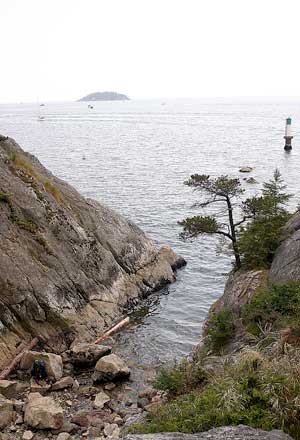
Upon arriving at Whytecliff it was the same ritual as always, take a look at the water, thank God I am lucky enough to have this kind of beauty in my back yard, and grab my gear to get it prepped. With everything unloaded and kits being assembled it was time to start planning out our day. The plan was to do our deep dive on what is called the "Cut". Now the cut is exactly what it sounds like, it looks like someone plunged a knife into the rock of Whytecliff park and drew a line back into the bay. Once in the water it drops very fast and runs off to the right to incredible depths and on the left you have the wall. Since this was the deep dive for the advanced certification, depth was the goal. The plan was quite simple, I would buddy up with the student and swim to her right with Allen just back and to the left. We would swim out staying along the wall and slowly make our way to a depth of 90 feet and then see how everyone was doing to see if we would go a little further. Then once in the bay we would circle around the point and head back into the bay making our exit easier....simple!
So with gear on and group together we headed towards the entry and down the rocky path and stairs. In the water, fins on, masks on, regs in, and down. It was almost as if we had been diving together a bunch of times, we descended as a group and in perfect position headed out along the wall. Then with a little signal the student my "buddy" pointed out to the right a bit and we angled a little away from the wall and into deeper water. With almost perfect control of our buoyancy we moved almost as one unit slowly descending and moving through the cut. Now I think it was the relaxed atmosphere or my intermittent ADD that caused it but I saw a fish and thought "Oooh shiny" and stopped to take a picture.. then kicked back to the group only to see another thing to take a picture of and another and another and another... Next thing you know I was swimming back of the group with Allen beside mybuddy and me busy taking pictures. This was pretty much how the dive finished, Allen and student together with me bringing up the rear. At 1500 psi, as discussed, we headed up a bit to 50 feet and continued, by this time, further into the bay until about 900 when we ascended to safety stop depth and swam in further before surfacing and kicking in.
Now, in between dives (good class dives especially) during your surface interval, you debrief and discuss the dive. What went good, what was not so good, what went according to plan, what went sideways and what would we do different next time. Allen (much like Ward in Row, Row, Row Your Boat Gently Into The Rolling Waves.... Merrily Merrily Off To See The Circus...) was great about reviewing the dive with his student and then, bum bum bum, with me.... You see, I broke one of the cardinal rules of diving (and of Top Gun) I left my buddy! My job was to stay to her right side and I decided to drop off to take pictures (hand slap time...ouch!)
Now for dive number 2, our Naturalist / Navigation dive, the plan for this one was quite simple. Gear-up, head into the water, finish the "navigational square" that had been incomplete in their dives the day before, and then proceed out along the wall looking for critters. Not a very involved dive and by keeping shallow and moving slow, this could be a good long dive... boy was I right...lol. For this dive, being a Naturalist one I elected (with Allen's permission) to just be the tag along photographer and not "dive buddy," this allows for me to take LOTS of pictures of all of the wonderful little creatures we find along the way. Everything for this dive went as planned, I once again dropped more weight bringing me down to 22 lbs of weight from the original 42 lbs I started with, and was feeling better than ever about my buoyancy. Down the hill we went and into the water, out to about 10 or 12 feet of water and descend to make a square, ascending upon completion brought us back almost to where we started, always a good start! Then back down again and over to the wall to do a very slow, swim along the wall looking at all the plants and creatures along the way. I must admit after about 20 minutes of our floating along I got concerned when I looked at my air and still had over 2000psi, then at 40 minutes with more than 1500psi left. Now my rational brain didn't take long to figure out that we were shallow and we weren't really kicking, more floating with the current and surge of the tide, so we we're breathing all that much. By about the 50 minute mark we had already started to head back and not going below 30 feet we didn't need a safety stop so we had time, but the most interesting thing started to happen... I got cold! Looking around I realized that I was not the only one, Allen and his student both looked cold too, which was funny because as soon as I looked at Allen, he gave me the "cold" signal to which I responded "cold" and we started moving in closer to shore and closer to the surface.
All in I ended dive 2 with close on 1400 psi left in my tank, still enough for another dive...lol, and we had been in the water for 59.6 minutes, a new record for me smashing my old record and nearly breaking 1hr of dive time!
The walk to the vehicles was a quick one, the wind was kicking up and we were already cold. Up to the cars, gear stripped off, sweatshirts and toques on and something warm in the stomach I was feeling loads better. Then to pack all the gear, fit it in totes and load it into the van. All done, it was time to sit and chat a few about the dive, make sure everyone was happy and everything accomplished. Time for Allen to sign off on the books and forms and then it was time to load up and head home.
Today marked dives 34 and 35, meaning once my Rescue courses are completed later this month (hopefully) and 15 more dives are done (hopefully soon) I will be qualified to receive my Master Scuba Diver designation. As exciting as that is, it is still a scary fact that according to the industry standards I will be recognized (regardless of association) as a Master Scuba Diver. That seems to me to be a whole lot of responsibility. I know it doesn't hold the same qualification or clout and Dive Master but to me it still seems BIG!! lol. Well, until the next time I get my nose wet and take my gear for a tour of the ocean, stay safe and I'll update you all soon... Photography is coming up!!!
So Many Things To Think About... So Little Time! For anyone who has ever said this to themselves or out loud... you are one step closer to becoming a Rescue Diver. Thursday night was my Rescue class with none other than Virpi Kangas, for any of you who are not aware of who Virpi is, you need to go back to the beginning of my blog and start over again, she is mentioned in almost every blog and is the reason I made it through my Open Water course and one of the ones who got me started on my road to Master Scuba Diver.... in short, she is a very important diver in my life. Now again, having Virpi as my Rescue instructor has a little irony to it, for any of you who don't know why this is ironic, you probably didn't take my advice from a moment ago to go back and re-read my blog so you could get to know a little more about Virpi. But for those of you who just like the direct route, those of you who watch Daytona and are left wondering why anyone would drive 500 laps around a course only to end up where they started... read this entry Seals to Emergencies and you will understand why it is interesting that Virpi would be teaching me to rescue people. So this was a small class, me Virpi and one student whom I had met when we did our EFR class together back in January. So after short introductions and some chat about diving experience and what we were hoping to achieve through the class we moved on to our chapter reviews... all 5 of them.... plus video.... all leading up to the... dum dum dum...
TEST!!!
The evening went by surprisingly quick, moving through so many questions and discussion points and video clips that your head began to spin... and this is where the title comes in. You see, to be an effective rescuer you need to be able to make split second decisions and follow through on them while being alert to everything that is going on around you. When you hear that call for help... you need to start making decisions and answering the internal questions immediately. You need to figure out are they panicked or just tired, what's wrong, where are they, can you reach them, what if you used a branch or an oar, can you wade in and reach them, can you throw them something, do you have to swim to them, can you use a boat, is a boat available, etc.... the list goes on of internal questions to ask yourself so that you can successfully plan and execute a rescue without getting yourself or anyone else in danger. So your brain is full of questions (and hopefully answers) and you haven't even started the rescue yet... this is why it takes split second timing, reactions, and thinking. So once you have decided on your course of action... like Nike said... Just Do It! Put your action plan in place, delegate responsibilities, coordinate responses, assign tasks. Then will all the action over, you need to be able to slow your mind down and rethink back through every step of the process so that you can document and report exactly what happened and only what you witnessed and not what others are telling you happened.
They say that as you move through and complete the Rescue and EFR programs you begin to view yourself and other divers differently. You start to evaluate and look closer at things you never would have thought about before. Is that persons gear on right, does it fit right, has it been altered, is that alteration going to be an issue in an emergency or cause an emergency... It all sits in your head when you look around. But for me it also hit me personally, I started to look at my personal health and well being. I'm not going to be much help if my excessive weight tires me out before I can get to them or get them back. What if my lack of Cardio or poor swimming is the difference between getting to someone in time and not.... So, it is my new goal, not only to become a Master Scuba Diver this year, but to look the part as well. When I enrolled in the Master Scuba Diver challenge I read the requirements, complete 5 specialty certifications, 50 dives and become a certified Emergency First Responder and Rescue Diver. I thought that would be an uphill battle, and on my own it would have been, but with support from home and my dive family I have completed more than the required certifications, more than half the dives, I am EFR certified and, if all goes well, next weekend I will be Rescue Certified as well. With all that considered I am a little less than 25 dives away from certifying as a Master Scuba Diver. But when I think Master Scuba Diver, I am left with the image of Gerard Butler in the shape he was in for 300.
So... all that considered, I am going to create my own "Master Scuba Diver Challenge" and commit to working hard on my own physical fitness so that should I ever be in a situation where I am needed I can perform with maximum efficiency and if I am unable to make a difference then I will know that it was not because of my training or conditioning. So I guess, long and short, I have only just begun my Master Scuba Diver Challenge and only learned that it is me that needs rescuing as much as anyone I will meet in the water. Hopefully before long I will be able to proudly accept my certification as a Master Scuba Diver and will somewhat resemble Mr Gerard Butler... without the chest hair, I can't grow chest hair.. but that's another conversation. This weekend is Boat Diver, should be a whole new adventure, but I'll tell you all about it next week as I prep to write my Rescue exam and complete my dives.
Now as bad as that title sounds, it's absolutely true! I am now officially a certified Emergency First Responder! Yeah me! This means that in case of emergency I can do CPR, perform rescue breaths and even use an AED (Automated External Defibrillator). Then once the life is out of danger I can control bleeding, apply splints, address bites, burns and blisters. But, I Just Don't Want To! It's not that I don't want you to be safe, harm free and healthy, it's that I don't want you to hurt yourself in the first place! and if you do insist on hurting yourself, then don't do it around me...lol. You see unlike my other dive related skills, specialties and certifications this is one that I hope to practice and never actually use!
Saturday was kind of an intense day, a full class of 7 students, including Chloe Boone, new shop employee, (she doesn't have a profile yet for me to link you to, but trust me, she works there...lol) all led by our fearless EFR instructor Steve Dunn, who (as you'll see from his profile) has been diving since before the days of BCD's and back-up regulators, etc. As he calls them "the wild west days," when you had a "J" valve and hoped it was done right or you were making an unplanned emergency accent to the surface so you could get air....lol. (If you have questions on "J" valves, send Steve a question, I'm sure he'd be happy to walk you through it, even maybe arrange for you to see one if you sign up for Open Water Certification and he can show you the advancements in equipment.)
So of course, as with all OPD staff, Steve was amazing right out of the gate, making everyone comfortable and walking everyone through the expectations of the day. A quick chance for everyone to share their names and dive experiences and why they are in the EFR class. Amidst the varying responses there was a common underlying theme, we all believe we will be safer divers if we, and those we dive with, are trained to handle emergencies. Of course this is probably a universal understanding that applies to every walk of life, you are inherently safer in the company of trained individuals.
Much of the start of the classroom time was similar to the other classes I have taken with Ocean Pro Divers, in that we started by pulling out our books and reviewing the knowledge review sections of our two manuals. But pretty much everything following the chapter reviews was all unique to the EFR course. Time was spent on the breakdown of equipment, the uses of the equipment and what to do if you have no equipment.
Through it all there was one recurring statement, doing something only partially right, is WAY better than doing nothing at all! Very simple concept, and remains that way after reviewing all the information and details. It has been proven that even if you forget steps, even if you make a couple of mistakes, by doing something you are giving them a chance, by not doing anything you could in fact be sentencing them yourself!
This topic and course are incredibly serious and as such, as some of you have probably noted, I have minimized the humor and reduced the fluff. I cannot express enough how much I believe that everyone, despite what activities you are involved in, should hold a valid first-aid or emergency first responder certification and practice and review regularly. While I will always extol the virtues of Ocean Pro Divers, their courses and especially their instructors, where the topic of life saving comes into play, don't let the fact that they are a dive shop be your excuse for not getting certified. If you don't dive PADI, go to a different shop, if you don't dive and don't want to be taught by divers (you don't know what you're missing) don't let that excuse you from being prepared. Look up Emergency Primary and Secondary Care and find a certified agency who can teach you and get it done!
Ok... so I am a day late with my update and my apologies to everyone who was looking for it yesterday as promised. Sunday was day one of my Search and Recovery course, which Shannon and Dennis graciously postponed from December so that I was able to attend. After meeting up with Dennis and Matt and the other two students in my class at Whytecliff, we got our kits put together and sat down to review the first half of our review questions. A quick once over of the questions showed that everyone had reviewed their manuals and despite a few questions we were all on the same page and anxious to get into the water. One final step of the surface review had us practicing and demonstrating our knots for Dennis and Matt. The three knots used and practiced in the PADI Search and Recovery course are the Bowline, Sheet-Bend and Two Half-Hitches.
The Bowline (in orange) is used for securing to a lift bag and/or to the object to be recovered from the bottom. This is a nice knot as (if tied correctly) the loop does not close, it just creates a loop that you can clip the lift bag or item to. The second knot (blue and white) is the Sheet-Bend, Bends are usually used to tie two lengths of rope together and this one does as good a job as any I have tried. Finally the Two Half-Hitches (white rope secured around the pole) is another knot used for securing to the lit bag or object to be lifted yet the key difference is that this knot tightens down on the object or clip it is attached to making this a good knot to use to secure to a section of the object to be lifted when you don't want the knot to move. All of these knots are fairly easy to pull apart making them good choices for underwater recovery.
For the knots I had purchased myself a few lengths of rope while studying so that I could practice as suggested in the manual. Of course the saying "Practice makes Perfect" is a misnomer, if you practice something incorrectly you only get perfect at doing it wrong. Only "perfect" practice makes perfect and since the book is a little unclear on the knots I was only practicing the Bowline and the Two Half-Hitches correctly. The Sheet-Bend however I got really good at doing wrong....lol. Fortunately Matt was able to show me a way to do it that made sense and got me and the rest of the class back on track with the Sheet-Bend while Dennis made sure everyone was comfortable with the other two knots.
With us all reasonably confident with our knot tying ability and after reviewing the skills to be covered in our dives one and two for the day, it was time to finish gearing up and head for the water to play Hide and Seek with ankle weights.
When it comes to diving I would have to liken it to riding a bike, while I have not been in the water in about 6 weeks, it took only a few steps into the surf before the nerves were calm and as soon as I started my descent I immediately felt at home. Visibility was amazing, the other students were confident in their abilities and along side the instructors we descended to the bottom with zero issues and almost no disruption of the bottom. After some quick signals between my classmates and myself we all fell into position and started our first search using, a Circular Search pattern. With one student / partner as the anchor or pivot point holding the rope and myself and the other student as the searchers holding the end of the rope taut, we start swimming making a large circle. If the "object" (in this case an ankle weight) is not found after the first complete circular pass then the anchor or pivot person lets out more rope and the searchers make another pass. In our case my partner found the object on our first pass and returned it to Dennis. Dennis had us swim a couple passes so that we would know what it was like anyway. Following this we made the short ascent to the surface, during which Matt had swam away to hide object number two, 16 lbs of weight. For the second search we were to do the U-Search pattern, where the navigator takes a bearing based on the approximate direction of the object and swims across the search grid with one of the partners counting kick cycles and remaining party members searching. Upon hitting the set amount of kick cycles you make a "U-Turn" and spacing yourselves out again you swim back along the same bearing searching for your object and turning again at your set distance or kick cycle count. This moves you in consecutive U's until you find the object. This time I got to play navigator and see if i could keep us on track and on our bearing, after a few passes we managed to find the weights and it turned out I wasn't to far off my navigation, yeah me for getting better!....lol. Once we found the object, with Dennis and Matt following behind us, it was time to show off our knots, but this time underwater. Dennis came up beside us all as we settled on the weights and he passed us all a section of rope which I was able to tie a Bowline in without any issue (1 down, 2 to go), after showing Dennis my Bowline and getting my congratulatory "ok" sign, he passed me another piece of rope, which I tied (thanks to Matt's predive surface tips) a Sheet-Bend to join the two pieces together. After showing the Sheet-Bend to Matt and getting his approval that the knot was complete, it was time to tie the Two Half-Hitches on to the band attached to the recovered object and then slip back and wait for the other students to finish up. Once everyone was done it was tie to check the connections and then while one student held the lift bag open and the other held the reel that was connected to the lift bag, I gently put air from my alternate air into the bag, testing it's buoyancy until presto, lift off and the bag was tracked slowly, with all the divers following behind, to the surface to finish a very busy and very successful dive number one.
Dive number two for the day wasn't going to be as busy, for this search we would descend at the same point and with one of the other students on Navigation and one counting I got to play Searcher for this pattern. For this search we were doing the Expanding Square pattern. This proves to be a difficult pattern if not thought out in advance. The concept is, you take a bearing, swim a set number of kick cycles turn 90 degrees and kick the same set of kick cycles, turn 90 degrees and kick adding a set number of kick cycles moving you past your start point and turn 90 degrees kicking a set number of kick cycles past your starting number. Sounds a bit confusing but the math is pretty simple. If you start swimming 5 kick cycles, turn and swim 5, then turn and swim 8 (adding 3) and then every time you turn you add 3 you end up constantly expanding your search area until you find the lost object. Simple right? Where this does get difficult is staying together....lol. You see the inside person is always the inside person, so if they turn and keep swimming, if you maintain your distance apart the outside person has not yet made the turn and falls behind and has to swim quickly to keep up, and then falls further behind on the next turn and the next one and so on and so on.... Guess where I was? You got it... the outside person. To make things more interesting, the navigator is an incredibly strong swimmer so I was being being left well behind the group. By turn three I was reminiscing about my fitness test and remembering how much I need to work to get back into shape (and round is not the shape I am looking for...lol.) After managing to get ourselves organized and making a couple of passes, sure enough I spot the target just out and to the left of us, unfortunately with falling behind I was unable to signal my team and we proceeded to do another, ever expanding, lap. By the time we had lapped back around the object was now on the inside of us, meaning we were doing the pattern correctly and not going over the same area too many times. Again the ropes were passed out, knots were tied and with me holding the bag and a different partner controlling each the reel and inserting the air, we managed to once again float our objective to the surface and with Dennis and Matt close behind, made our slow and controlled ascent to the surface to finish dive 2.
Now for those who haven't gathered already, I am not in the best shape of my life. As such I tend to breathe through my air faster than most which, as mentioned in previous posts, has led to me having to surface earlier than wanted due to lack of air. So in November I bought myself brand new steel 130's. These tanks hold WAY more air and, despite their weight, are wonderful to dive with. After finishing dive one for the day I had a little over 1000 psi of air left, normally I am finishing with just over just under 500 psi so this was incredible. After dive 2 I had more than 1700 psi left in the tank so, at Dennis' suggestion, my dive buddies and I swam out to the point and descended for a third dive. This dive was just a calm and relaxed drift back towards shore along the wall of Whytecliff. There was not a lot to see, lots of starfish, a few crab and a couple of fish, but more than that it was just a great time to take it easy and dive with friends in a completely relaxed atmosphere while enjoying our surroundings.
This weekend should be an exciting one with my Emergency First Responder training at the shop on Saturday and who knows what this Sunday will bring as my dive team and I get back in the water to finish off the last two dives for our Search and Recovery certification.
My apologies to Mr Gene Kelly for killing his song but this is what I was up to earlier today. Last night brought in a few inches of snow and this morning we were scheduled for day one of Deep Diving with Mr Roger K.L. Fordham, Master Scuba Diver Trainer with Ocean Pro Divers. Last night he had messaged to advise that much like the postal service we were going regardless of weather, so when my alarm rang just after 5:00 am and I managed to crawl out of bed I knew it was going to be an interesting day. Grabbing my gear, lunch and a coffee and dressed in warm undergarments it was time to make my way through the snow and clear the van for my drive up to Whytecliff.Park.
Fortunately my dive partner and Roger are like me and like to get going early in the morning so that you can enjoy your dives and still get home at a reasonable time and still have your afternoon free. So by just after 7:00 am the three of us were gearing up and reviewing the dives for the day. By shortly after 8:00 we are headed to the water and excited about the first of our Deep Dives.
Dive one was a simple navigation objective, swim out, signal, descend, find a place on the wall roughly 100 feet down and then with my dive partner swim away from the wall in a straight line maintaining 100 feet for 20 kick cycles, stop, turn and return on the same path back to where Roger is waiting for us. Process sounds simple enough, only issue, I apparently developed a cold, not usually a problem if you are sitting at home wrapped up drinking tea and eating soup... but when you're intending on diving beyond 15 to 20 feet you need for your ears to be able to clear... mine were not so willing....lol I managed to get a little equalization during the first part of the descent but by the time I had hit around the 25 - 30 foot mark my ear was having none of it. Signaling to my partner and Roger, I ascended a few feet and a few feet more trying to get my ear to clear, nothing! After a few more tries Roger signaled me over to the rock face where I was able to hold on and with the rest of my body immobile and with a final attempt my ears did what they were supposed to and with a very satisfying feeling my ear cleared and equalized with the wonderful sound only a clearing ear can make...lol. With my ear cleared we pushed off the wall and proceeded with our decent to 100 feet. Man I love diving! So much to see! So much to do! So after a nice gentle decent to 100 feet we continue as planned, Roger in his spot on the face of the wall, my dive buddy and I hovering at 100 feet, take a compass bearing, and swim directly away from the wall. Out 20 kick cycles, counted by my buddy, turn and shift into position so i can count cycles while he leads the return swim back to Roger and we are right on the money. With this dives skill component completed it's time for some fun, Roger pulls out of his bag what was once a normal empty 2 liter pop bottle, it is now compressed like it was run over by a truck, all of the air is condensed and pulled the sides of the bottle in on itself. Next we look at some pieces of Neoprene, on the surface some are significantly thicker than others, but down at 100 feet they all appear to be almost exactly the same thickness, lastly Roger grabs an egg from his bag, a little tap tap with his dive knife, opens the shell and out floats a perfect yellow ball. After a few minutes of playing with the egg it's time to leave it for the fish and head off, then after a little exploring, some pictures, a little video we arrive back at 15 feet for our 3 minute safety stop.
After a short surface swim back in and a walk up to the vehicles, it's time to take off our kits, switch tanks and get some food in us while we review the plan for dive 2 and kill the balance of the hour and a half required surface interval to get all the excess nitrogen out of our system.
With the surface interval drawing to an end, Roger gets out his preschool shape sorter...
What a great toy... this little square with individual shapes teaches children to recognize shapes and then focus on finding the similar hole and then coordinate their motor skills to fit the piece in the hole! This has been used for decades with preschoolers, children with autism and now, Deep Divers!
You see, all gases have a narcotic effect to them and as you descend to 100+ feet nitrogen can build up and cause what is know as Nitrogen Narcosis, or you become what is usually called Narced. Being Narced is like being intoxicated, your motor skills suffer, you can get tunnel vision, have focusing issues, etc. So we try the shape sorter on the surface, then at 10 feet and then again at 100+ feet to see what the time difference is and see how bad, (if at all) we get Narced.
Once again, we put on our kits, make the walk to the beach and start our surface swim out to our first descent point. Sitting in about 10 - 12 feet of water we start attempt number one after just over a minute I am done and all pieces are in the cube. After my dive buddy finishes his turn it's time to head out to the depths. When we reach decent point 2 we exchange a signal and start our relaxed descent back down to 100 feet clearing and equalizing the whole way. This time is much easier and taking it really slow my ear stays clear and equalizes with only minor work. Once on the bottom it's time to play with the shape sorter again, Roger passes me the sorter, signals, starts the time and opens the bag, one after another the pieces come out of the bag, into my hand and flipping the sorter around each piece finds its home in under a minute. As it turns out, I am apparently faster at 100 feet then I am at 10 feet... wonder if that would work for my office stuff too...hmm...lol. After my partner has his turn, the toys are put away and it's off for a bit of a swim before heading back towards shore, our safety stop, surface swim, gear down and drive home. Another successful day of dive adventures, and half way to being a certified Deep Diver.
This will end up being a short addition to the blog posted earlier talking about my first recreational dive without instructor supervision. After our dive for the day we headed back to my place to move all the rental equipment from Scott's car to my van so that I could drive it out to the shop to return it and meet up with Master Scuba Diver Trainer Roger K.L. Fordham hoah! Every time I see Roger I feel like saluting, which as I later found out wouldn't be to far off as he serves in the military. I had met Roger previously and as mentioned in If it ain't broke don't fix it.... and from SORTED to super STARS and Shooting Pumpkins and Making Squares.....I had seen him at work as an instructor. Today, though would be my first day to actually start training under his supervision, I was excited and rightfully so. Roger was quick to get into the chapter reviews and alternating between me and my dive partner for this specialty we reviewed all the answers, made any corrections necessary (not that I had any errors..lol) and answered any questions anyone had. Next we moved on to planning our dives. Seeing as both my dive buddy and I had recently completed our Advanced Certification and on that you end up completing one of your required dives for your Deep Certification we only really had to complete 3 dives. But seeing as we were already going to be at the site, why not bring the second tank on both days and enjoy the extra dive. Roger, being very detailed, like a briefing prior to a military operation, walked us through the initial plan for when and where we were meeting, the planned dive profile for each of the 4 dives, and the skills required to complete the specialty. Needless to say I was excited to be prepping for these dives and can't believe that in less than a week I will be 130 feet deep in the open ocean. Apparently we get to play with kids toys and crack an egg under water... can't wait to see what that is like. Maybe I'll see if I can get a camera and try to capture some shots of what I see. Anyway, time to get back to the family, can't wait to let you all know what it's like at 130 feet, I'm sure it will be an experience.
Last night marked one of the most amazing experiences (so far) that I have had diving! On the final night of my Night Diving certification, and in preparing for my final dives I was, understandably, a bit nervous. The night was to consist of Night Navigation, essentially for dive one of the evening my dive buddy and I were to lead a tour out along Whytecliff towards the day marker, and at approximately half air, turn around and return back to the start, including the safety stop, with 500+ PSI in the tank. We almost made it... lol. We led the tour out, apparently swimming faster than normal, and covering a lot of ground, saw a ton of great stuff and even crossed over the point. In one area we even dropped below 70 feet (I later found out this was a no no as my buddy was not advanced certified yet...ooops). The swim back was good, but we went with the rock instead of over at one point which would have had me lead the group parallel to the beach and not towards it. Fortunately Dennis was there and corrected my trajectory pointing us back on track (Navigation has never been my strong suit). After our safety stop, and a nice controlled ascent the final 12 feet to the surface I finished with just under 400 PSI, not too bad, but not where I wanted to be.
Dive 2 on the night and #3 for the Night Diving course was where my life was changed forever... at least in the realm of diving. We were on our tour of Whytecliff, happily following Dennis out through the very dark water and just enjoying a leisurely swim when Dennis' light locked onto something on the ground I could not quite place. Following tight to his right side with my dive buddy slightly back and left of me and our DM just back of that we started a very controlled circling descent down to see what Dennis had locked in on. To my surprise, and apparently Dennis', the DM's and everyone else that has heard the story, there in the middle of the sandy bottom, moving at a leisurely pace, perhaps hunting, was a medium sized Pacific Octopus! Rarely if ever seen out of their dens at the best of times and almost never seen out in the open especially in local waters, this was an opportunity of a lifetime! Now unfortunately, due to this being a course, no one had their cameras and Dennis did not have his video camera as he was teaching, so no pictures or video footage to show but I can tell you it was SUPER cool!
After swimming with the octopus for a while and watching it chase fish, we carried on for a bit more of a tour and then headed back in for our final skill of the night, and the course.... the dreaded BLACK OUT!! You see I had heard about this skill in the book and in class, the idea being to mimic and light failure. Can you sit in the dark for a full 3 minutes, just sitting / laying there, and then in the dark, locate your back-up light, activate it and complete the dive with nothing but the back-up? When it came to the impending moment, Dennis swung around to face us, and killed his light. Following suit, we one by one shut off ours and with nothing but the phosphorescent and our tank lights we sat for 3 minutes... or nearly 3 minutes...lol. I was closest to Dennis, and after a minute or two your eyes really adjust to the low light and darkness and you can start to make out everything. At about this point Dennis got my attention and signaled to me, not totally understanding what he was looking for me to do, but knowing pretty much the only thing left to do was locate and use the back-up, I found mine and turned it on. Seeing the light, my dive buddy found and turned on his, followed by the DM and then Dennis. It wasn't until after the dive that Dennis let me know he was signaling for me to let him know what my air was at...lol, it was not time to turn on the lights....lol. With lights on, Dennis started a leisurely swim towards shore showing us some of the interesting items in the shallow water and before I knew it, my depth was 4 feet and I could stand and take my fins off. BEST WAY TO FINISH DIVES EVER!..lol.
Up to the vehicles for one last time, strip off the gear, load up and head home, a certified Night Diver.... yeah me!
"Under the seaUnder the seaDarling it's betterDown where it's wetterTake it from meUp on the shore they work all dayOut in the sun they slave awayWhile we devotin'Full time to floatin'Under the sea"
This song has been "floatin'" through my head since my last dive a little over a week ago. For any of you who have never been down 60' you can't really apreciate what Sebastian and I have been singing about. For anyone who has been down there and deeper, you know that it truly is, "Better down where it's wetter! Under the Sea!"
Just a quick update over the past few weeks, especially while completing my Open Water Course and talking about future dives and courses, I have received several comments from people, either in person, on Facebook, or via email asking me what was next and when and where was I diving. So I have created the "In Over My Head" Calendar, I have detailed on it the courses that I have already signed up for that will be taking place over the next 12 months and i will be updating the calendar with any of the fun or recreational dives I will be doing. If any of you have an interest in joining me for any of the courses feel free to contact me or Ocean Pro Divers and we'll make sure you all set up. If anyone is looking for a dive buddy and you want to join me on one of my dives, send me a message and we'll get it sorted out, also in any of you are planning dives and you are interested in having more in your group let me know and if I can make it I will add it to the calendar and we'll get it all set-up.
Keep checking back for updates or sign up and follow the blog so you don't miss any of the action next week when I start my Advanced program with Virpi.
Last night brought the last and final classroom and pool sessions for my Open Water course, we were again happy to have Mathew Mendes join us in class and in the pool and the always wonderful Virpi Kangas was able to walk everyone through their questions and put everyone's minds at ease over the upcoming impending 50 question final exam! It was a good class, again most people had their homework done and it was great to have a few minutes to discuss gear with Matt and Shannon. They were able to educate me on the downsides of buying used equipment especially regulators, especially given the cost of service and the warranty on new ones. Case in point, (actual example) I was looking at a used Apeks XTX 200, only $400! New, this reg is $800, that's half off!! What Shannon was nice enough to point out though, is (1) this is your most important piece of equipment, without it, you don't breathe, (2) a used one will need to be serviced, add $150, plus any parts count on at least $100 (if not more), plus any additional parts down the road. A new XTX 200 comes with a lifetime parts warranty and won't need servicing for a year (all regs should get serviced every year). Overall, used is $650+, and any parts until the end of time... a new one is $800 parts included... for $150 (or less) in difference, I'm going new. Shannon and Matt were also great enough to walk me through how to check tanks (as this is an item Shannon says can be a great deal used), they showed me where to look for the inspection labels, hydro stickers and engraved codes required on tanks in Canada. All things that if you didn't know about could result in spending a ton of money.... twice! Once to buy the "Great Deal", and once to pay full price for one you can actually use. The conversation then turned to Dry Suits (which I was learning how to dive last night) and what to look for and the different levels and costs and accessories... etc. Bottom line, if you want to do this right... it's not cheap!
As mentioned, class was great, we reviewed our Review Questions, and took our quiz... 10/10.. yeah me! and then watched our Dry Suit video, and then got into the discussion (this was one of our review questions) on next steps beyond Open Water certification. These steps include, Adventure Diver, this includes a taste of a couple of specialties (typically Deep Diver and/or Wreck Diver), then Advanced Diver, this includes LOTS of specialties to chose from and you get to try out 4 or 5. Then there is the big daddy of them all, the one I am looking at, the Master Scuba Diver Challenge! In this program you get all 12 offered specialties over the course of the year, your Advanced Diver and your Rescue Diver certifications. This is the highest level of recreational diving and the door way to Dive Master and beyond if one is interested. You end up saving almost half the cost over what you would pay if you paid for each specialty separately. This is an amazing deal!
Last night finished at the pool as we learned and practiced our "dry" suit training. After practicing our Controlled Emergency Swimming Ascent, righting yourself from an upside down (feet first) ascent, buddy breathing, mask recoveries (yes, again...) and practicing our Neutral Buoyancy we exited to clean up and found out that Dry is a relative term, I WAS SOAKED!! Apparently doing aquatic acrobatics is not conducive to keeping all your seals closed... I have been moderately assured that I shouldn't leak in the cold ocean... at least, not as much... weee! Well, here's looking forward to an early Saturday morning, and my first of 5 Open Water ocean dives.